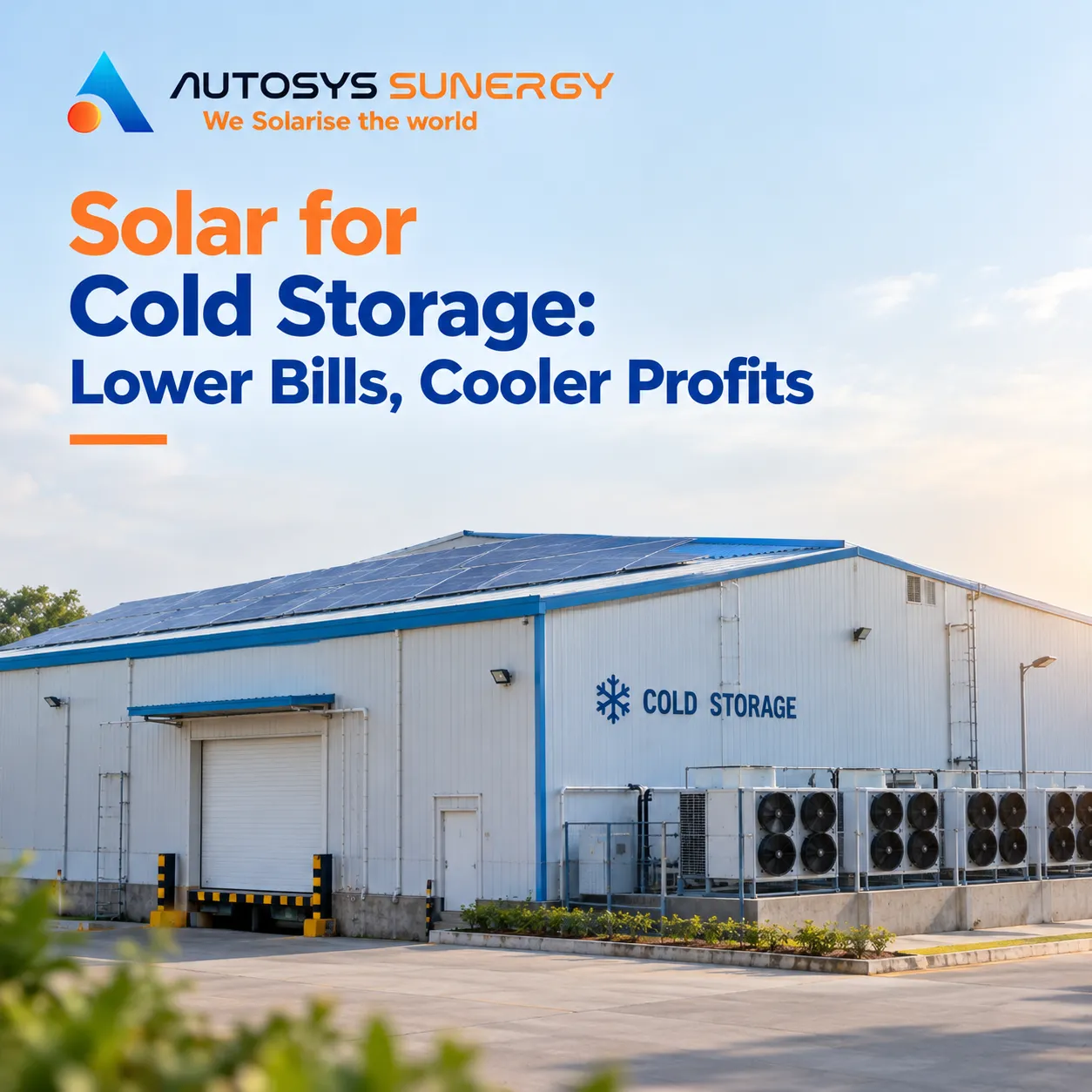
A 300 kWp rooftop solar system for a 5,000-tonne cold store could generate around 4.5 lakh units of electricity a year, potentially offsetting a substantial share of the facility’s annual consumption. The actual investment and payback depend on the roof-mounting method, electricity tariff, seasonal operating pattern, metering arrangement and how much solar generation can be used or credited.
For cold-storage operators in Madhya Pradesh, one detail deserves particular attention before accepting a solar quotation: the tariff category and seasonal billing option used to calculate savings. A proposal based on the wrong tariff assumptions can materially overstate or understate the financial benefit.
No, you do not get an agricultural tariff
This is one of the first questions cold-storage owners ask, and the applicable tariff schedule is the right place to start.
The MPERC FY 2026–27 retail supply tariff order specifically lists cold storage under LV-4 for low-tension supply. The applicability wording also covers other specified industrial and food-processing activities, including flour mills, dal mills, ice factories and units processing agricultural produce for preservation or to increase shelf life. High-tension consumers must check the relevant category and conditions in the same tariff order.
Cold storage should therefore not automatically be assumed to qualify for an agricultural electricity tariff simply because it stores agricultural produce. The applicable category depends on the tariff schedule and the consumer’s actual connection.
The MP Industrial Promotion Policy 2025 should also be reviewed separately if you are assessing incentives. Do not assume that a policy incentive available to one category of agricultural, dairy or food-processing unit automatically applies to a standalone cold-storage facility. Eligibility depends on the specific provision, registration and approval conditions.
Key takeaway: confirm your exact tariff category, voltage of supply, applicable electricity duty and any incentive eligibility before calculating solar savings. A higher avoided electricity cost can improve payback, but only if the calculation uses the charges that solar can actually reduce.
What you actually pay per unit
For FY 2026–27, the applicable energy and fixed charges depend on the consumer category, voltage, location and billing arrangement. For example, the MPERC tariff order lists the following for LV-4 non-seasonal consumers:
- LV-4, low-tension industrial: the order lists an urban energy charge of ₹7.05 per unit, with a monthly fixed charge of ₹336 per kW or ₹269 per kVA of billing demand. Rural charges differ.
- High-tension supply: the applicable category and its energy-charge structure must be checked against the current tariff schedule. Do not use a rate from another category or voltage level without verifying that it applies to your connection.
For the official rate tables and conditions, refer to the MPERC FY 2026–27 tariff order.
The important point for solar modelling is that the average cost on your bill is not necessarily the value of every unit generated by your solar system. Fixed or demand charges may remain payable, and the value of solar generation depends on when it is consumed, how the tariff is structured and how surplus electricity is settled.
Cold stores often operate compressors for extended periods during the storage season. That can produce a high load factor, but the actual monthly pattern varies with the crop, storage temperature, plant efficiency, ambient conditions and operating practices. Do not assume that every facility consistently operates above a particular load-factor threshold without examining its bills and demand data.
For example, if a cold store imports 115,000 units in a month and its solar system generates 25,000 units, the financial benefit should be calculated using the applicable rate and settlement treatment for those units—not by multiplying generation by an unverified average tariff.
In simple terms: ask your installer to show the tariff rate used for each unit of expected solar generation, explain how fixed charges are treated and reconcile the model against your actual electricity bills.
The seasonal tariff clause that can change the calculation
Cold-storage operations can have a strong seasonal pattern, so it is worth checking whether a seasonal tariff option is available and beneficial for your connection.
The applicable tariff schedule sets out the conditions for seasonal consumers, including the definition of a seasonal industry, the permitted season and the charges payable during and outside that season. Eligibility and compliance must be checked against the current order and the conditions applicable to your connection.
Do not assume that every cold store qualifies automatically or that selecting a seasonal option will always reduce the total bill. The effect depends on your operating calendar, recorded demand, monthly consumption and the exact seasonal tariff provisions.
Before comparing solar proposals, have the installer model at least two cases where applicable:
- Non-seasonal tariff: calculate savings using the applicable non-seasonal energy charges and the actual monthly consumption profile.
- Seasonal tariff: calculate the bill across the declared season and off-season, applying the relevant energy and fixed-charge provisions and checking whether the eligibility conditions are met.
The off-season rate and any additional conditions must be taken directly from the applicable tariff order. They should not be inferred from a general rule or copied from a previous tariff year.
Key takeaway: tell your installer which tariff option you are on—or whether you are considering one—before the savings model is prepared. Ask for a side-by-side annual bill comparison rather than relying on a single blended rate.
Which six months you declare is worth more than the option itself
Where the seasonal tariff rules restrict the length of the declared season, choosing the months requires careful analysis. The months in which a crop is commonly stored do not necessarily match the months in which your own facility consumes the most electricity.
A store may begin loading after harvest, run its refrigeration equipment heavily through hot weather and then reduce operations as the stock clears. Actual patterns vary by crop, location, storage practices and customer contracts.
Before submitting a seasonal declaration, review:
- Twelve months of electricity bills and recorded demand.
- Monthly consumption and the facility’s actual loading and unloading dates.
- The seasonal tariff’s maximum permitted season and its definition of off-season consumption.
- The demand and consumption limits that apply during the off-season.
- The effect of any breach, including whether the tariff order provides for retrospective billing under the non-seasonal tariff.
Do not rely on illustrative figures such as a ₹1.2 lakh annual difference between two possible seasonal declarations unless they have been calculated from the facility’s actual bills and verified against the current tariff provisions.
Solar can reduce electricity imported from the grid during off-season months, but whether that reduction counts towards a seasonal-consumption limit depends on the precise rule and how the discom measures consumption. That question should be resolved before the seasonal tariff is included in a financial forecast.
In simple terms: choose the declared months using your actual consumption and the tariff conditions—not just the crop calendar. Have the discom confirm any unclear eligibility or measurement rule in writing.
The crop calendar and the banking year may work together
One of the potential advantages of a seasonal cold store is that its electricity consumption can rise and fall substantially during the year. Solar generation and electricity settlement must be modelled against that pattern.
A potato store, for example, may load after the harvest, use more refrigeration during warmer months and operate at a lower level during some winter months. Other crops and storage models can follow different schedules.
The important question is what happens to solar energy generated when the facility’s immediate consumption is low. Under the applicable grid-connected renewable-energy and metering rules, the treatment of exported electricity, energy credits and any surplus at settlement depends on the approved arrangement and the regulations in force.
The MPERC regulations for grid-interactive renewable energy systems provide the relevant regulatory framework. Do not assume that every unit exported in winter will automatically be carried forward and offset against consumption in summer, or that all unused credits will be paid at retail tariff. The approved metering arrangement and settlement provisions determine the result.
A 300 kWp array may generate a meaningful amount of surplus during lower-load periods. The financial model should show, month by month, how much generation is self-consumed, how much is exported, how credits are carried forward and what happens to any remaining surplus at settlement.
Daily operating patterns also matter. If compressors and evaporator fans run during the same daytime hours in which the solar array generates, direct self-consumption can be substantial. This must be checked against the facility’s actual load profile.
Key takeaway: a seasonal load can create opportunities for solar, but the benefit depends on the settlement rules and your actual consumption. Ask for a month-by-month generation, import, export and credit forecast.
You may not need a battery, and the reason is in your chambers
Cold storage runs outside solar-generation hours, which leads some owners to assume they need a battery. A battery is not automatically necessary, but neither is grid-based energy banking available on identical terms under every arrangement.
First, determine whether the approved metering arrangement permits the export and later adjustment of solar energy, and what value and settlement conditions apply. If the grid arrangement already provides an economically useful way to offset imports at another time, a battery may not be justified solely to shift daytime generation into the evening.
Second, the stored product and insulated chamber can offer limited thermal flexibility. Under the guidance of a refrigeration specialist, a facility may be able to adjust cooling schedules or setpoints during periods of solar generation and reduce compressor operation later, while keeping the product within safe storage conditions.
The available flexibility depends on insulation, chamber design, refrigeration capacity, crop type, product temperature requirements, humidity, operating procedures and food-safety requirements. It should be established through an engineering assessment, not assumed from the tonnage stored.
There is an important limit: potatoes intended for processing can be sensitive to low storage temperatures because chilling injury and changes in sugar content can affect processing quality. The acceptable temperature range depends on the variety, intended use and storage protocol. Onions, garlic and other products also have their own storage requirements.
In simple terms: assess controls and thermal flexibility before investing in batteries, but do not compromise product quality or refrigeration reliability. Your crop and operating requirements determine how much load shifting is practical.
The roof is a genuine engineering problem
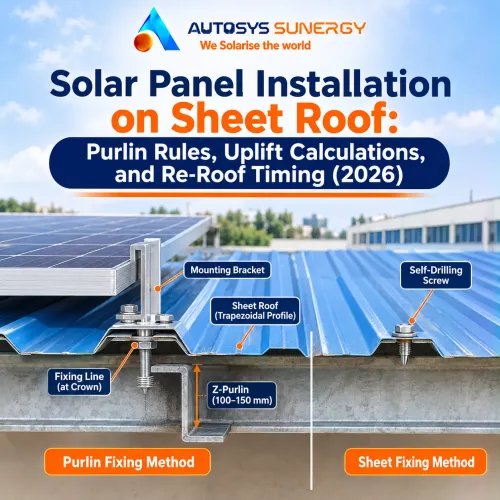
Many standard rooftop solar installations use rails and mounting hardware suited to conventional metal-sheet roofs. A cold store may instead have an insulated sandwich-panel roof, often constructed with two metal skins and an insulating core.
These panels can be vulnerable to inappropriate drilling, loading and detailing. Penetrations that compromise the outer skin or vapour barrier can allow moisture ingress and damage the insulation. The extent of the risk depends on the panel construction, installation detail and local conditions.
The mounting design must therefore be developed for the specific roof. Depending on the panel profile and structural arrangement, possible approaches may include engineered non-penetrating clamps compatible with the panel manufacturer’s system or a secondary frame that transfers loads to suitable structural members. Neither solution is universal: both require confirmation of structural capacity, wind loads, panel limitations and manufacturer requirements.
An insulated-roof installation may cost more than a conventional sheet-roof project. However, the premium should be based on an actual design and quotation rather than a fixed allowance applied to every facility. Ask bidders to separate the mounting structure, engineering, waterproofing details and any additional access or safety work.
Solar modules can shade part of a roof, but any resulting reduction in cooling load is site-specific and should be treated as a secondary benefit unless it has been modelled or measured.
Safety also needs early attention. Cold stores may have refrigeration plant rooms, electrical equipment and hazardous areas requiring particular precautions. Cable routes, inverter locations, isolation points and access must be planned with the site’s safety requirements in mind. Our industrial solar installation work in Indore provides further context for assessing solar on operating industrial sites.
Key takeaway: ask every bidder to explain exactly how the system will be mounted on your insulated roof, where the loads will transfer and how penetrations—if any—will be sealed. Do not approve a method that compromises the roof’s insulation or waterproofing.
How big a system, and what it covers
A cold store’s electricity use depends on its capacity, crop, operating temperature, insulation, refrigeration equipment, occupancy and local weather. A single annual consumption figure should therefore be treated as a planning assumption, not a universal benchmark for every 5,000-tonne facility.
Before sizing a system, examine:
- Contract demand and sanctioned load: confirm the approved electrical capacity and actual recorded demand. Tonnage alone is not enough to size the solar system.
- Compressors and evaporator fans: these can represent a substantial share of the electricity consumption, but their actual contribution should be measured or estimated from equipment ratings and operating hours.
- Usable roof area: allow for walkways, access routes, roof equipment, structural limitations, shading and safe maintenance clearances.
- Solar generation: estimate annual output using the proposed DC capacity, location, orientation, tilt, shading and expected system losses.
- Self-consumption and settlement: calculate how much energy will be used directly, exported or adjusted under the approved metering arrangement.
A 300 kWp system may generate around 4.5 lakh units a year under a suitable design and favourable site conditions. Treat this as an illustrative estimate and confirm it with a project-specific generation assessment. The percentage of annual consumption covered will depend on the cold store’s actual electricity use.
Do not assume that every unit will automatically be monetised at the full retail tariff. The outcome depends on the load profile, metering arrangement, settlement rules and any applicable export or system-capacity restrictions.
For larger systems, the permitted capacity and metering arrangement require particular attention. Do not assume that a universal 500 kW net-metering cap applies to every behind-the-meter or captive installation. The applicable MPERC regulations, their amendments and the discom’s approval conditions must be checked for the proposed project.
Our 500kW guide for factory owners and cost-per-MW guide for Madhya Pradesh provide additional context for evaluating larger installations and project structures.
In simple terms: size the system using the usable roof, electrical connection, load profile and applicable rules together. Do not size it from storage tonnage alone.
What the numbers look like
Consider an illustrative 5,000-tonne potato store in the Malwa region, with a 200 kVA connection and approximately 3,000 square metres of insulated roof. These details are assumptions for an example, not a description of every cold-storage facility.
Suppose the proposed solar system is 300 kWp and the base installation rate is ₹45,000 per kW. The base cost would be approximately ₹1.35 crore before any applicable GST. If GST were 8.9%, the arithmetic would produce a total of roughly ₹1.47 crore including GST. However, the applicable GST rate and tax treatment must be verified with the supplier and the facility’s tax adviser. The mounting design should also be explicitly included in the quotation: if it is charged separately, it must be added to the project cost rather than silently excluded from the payback calculation.
For an illustrative annual generation estimate of 4.5 lakh units, the annual financial benefit must be calculated from the electricity charges actually avoided, the facility’s monthly load profile, the treatment of exported energy and any additional operating costs. Demand or fixed charges may continue even after solar installation, and electricity duty and other bill components must be assessed under the applicable rules.
Payback cannot be stated reliably from system capacity and annual generation alone. It requires the complete project cost, the tariff that applies to the units offset, maintenance costs, credit settlement, financing assumptions and tax treatment. A four-and-a-half-year payback may be possible for some projects, but it should not be presented as a guaranteed result without a verified bill-based model.
Accelerated depreciation may affect the after-tax economics if the owner and asset qualify under the applicable tax provisions. Its value depends on the tax position and should be calculated by the facility’s chartered accountant rather than represented as a fixed percentage saving.
What the calculation should show separately:
- The solar project’s complete installed cost, including the roof-mounting method, electrical work, GST treatment and other applicable charges.
- The annual generation estimate and its assumptions.
- The energy charges avoided through direct self-consumption.
- The value and settlement of exported energy, where permitted.
- Any demand or fixed charges that remain payable.
- Annual operation and maintenance costs, expected degradation and downtime.
- The effect of applicable taxes, depreciation and financing.
Key takeaway: use a transparent, bill-based model rather than a headline payback number. If a proposal promises an unusually short payback, ask the installer to show the tariff, monthly generation and credit assumptions behind it.
What to settle before you commit
Four things should be checked before you approve the project.
First, confirm your tariff category and whether a seasonal option is available and beneficial. Second, review your contract demand, recorded maximum demand and monthly consumption over a full twelve-month period. Third, confirm the roof construction and obtain an engineered mounting proposal. Fourth, establish how the proposed system will be connected, metered and settled under the applicable regulations.
One additional question deserves written confirmation from the discom: how will exported solar energy and grid imports be treated when determining compliance with any seasonal-consumption or demand limit? Do not assume that solar exports automatically reduce the consumption figure used for every tariff condition. The answer depends on the exact wording of the rule and the approved metering arrangement.
Send us twelve months of electricity bills, your tariff category, the connection details and information about the roof construction. AutoSys can help estimate the system size, model generation against the facility’s load profile, compare applicable tariff scenarios and prepare an indicative project quotation. A complete solar EPC scope for a cold store should clearly define the mounting method, structural assessment, electrical work, metering and discom documentation.
Pricing across commercial system sizes is covered in our commercial solar cost guide, while our 200kW cost and ROI guide discusses the economics of a medium-scale installation. You can also start with an assessment of industrial solar installation for your facility.
Frequently asked questions
Does a cold storage unit get an agricultural electricity tariff in MP?
Do not assume that it does. The MPERC FY 2026–27 tariff order specifically lists cold storage under LV-4 for low-tension supply, with the applicable high-tension category and conditions to be checked separately. Confirm the tariff category printed on your bill and the current order before budgeting.
Is solar worth it for a cold store?
It can be, particularly where refrigeration equipment operates for long hours and the facility has sufficient usable roof area. The return depends on the installed cost, solar generation, tariff, seasonal load profile, settlement rules and maintenance costs. Obtain a bill-based financial model before relying on a particular payback period.
Why are my solar savings lower than the proposal said?
Possible reasons include using an average tariff rather than the charge actually avoided, counting fixed or demand charges as savings, overstating annual generation, overlooking export-settlement conditions or using an inaccurate monthly load profile. Ask the installer to reconcile the proposed savings with your actual bills and show the calculations.
Does the seasonal tariff option change the solar calculation?
It can. The seasonal option may change energy and fixed charges during and outside the declared season, subject to the applicable tariff conditions. Compare the annual bill under the seasonal and non-seasonal options using your actual monthly consumption and demand data before deciding which arrangement is more economical.
Do I lose my solar generation when the store is empty?
Not necessarily, but the treatment of surplus depends on your approved metering arrangement and the applicable settlement rules. Verify how exported energy is credited, how long credits remain available and what happens to any unused balance at settlement. Do not assume that all surplus will be carried forward or paid at the full retail tariff.
Do I need batteries to run compressors at night?
Not automatically. First assess the approved grid-metering arrangement, the value of exported energy and the possibility of shifting some cooling demand within safe operating limits. A battery should be evaluated against its installed cost, usable capacity, efficiency, replacement needs and the value of the energy it can shift.
Can solar panels be fixed to a cold store’s insulated roof?
Yes, provided the mounting design is suitable for the specific roof and does not compromise its structural integrity, insulation or waterproofing. Depending on the panel and building design, an engineered non-penetrating system or a secondary frame transferring loads to structural members may be appropriate. The mounting method must be verified by a qualified designer and should comply with the panel manufacturer’s requirements.
How much of my roof can I use?
It depends on the roof’s usable area, orientation, shading, structural capacity, access routes and the space needed for existing equipment. A 3,000-square-metre roof may accommodate a substantial array, but a figure such as 300 kWp should be treated as an initial estimate until a site survey and layout design are completed.
Is there a subsidy for solar on a cold store?
Do not assume that a general cold-chain or agricultural-infrastructure incentive also subsidises a rooftop solar system. Eligibility depends on the specific scheme, applicant, project type and current guidelines. Commercial and industrial buyers should separately assess the applicable tax treatment, depreciation and any available incentives with their chartered accountant or project adviser.
Keywords