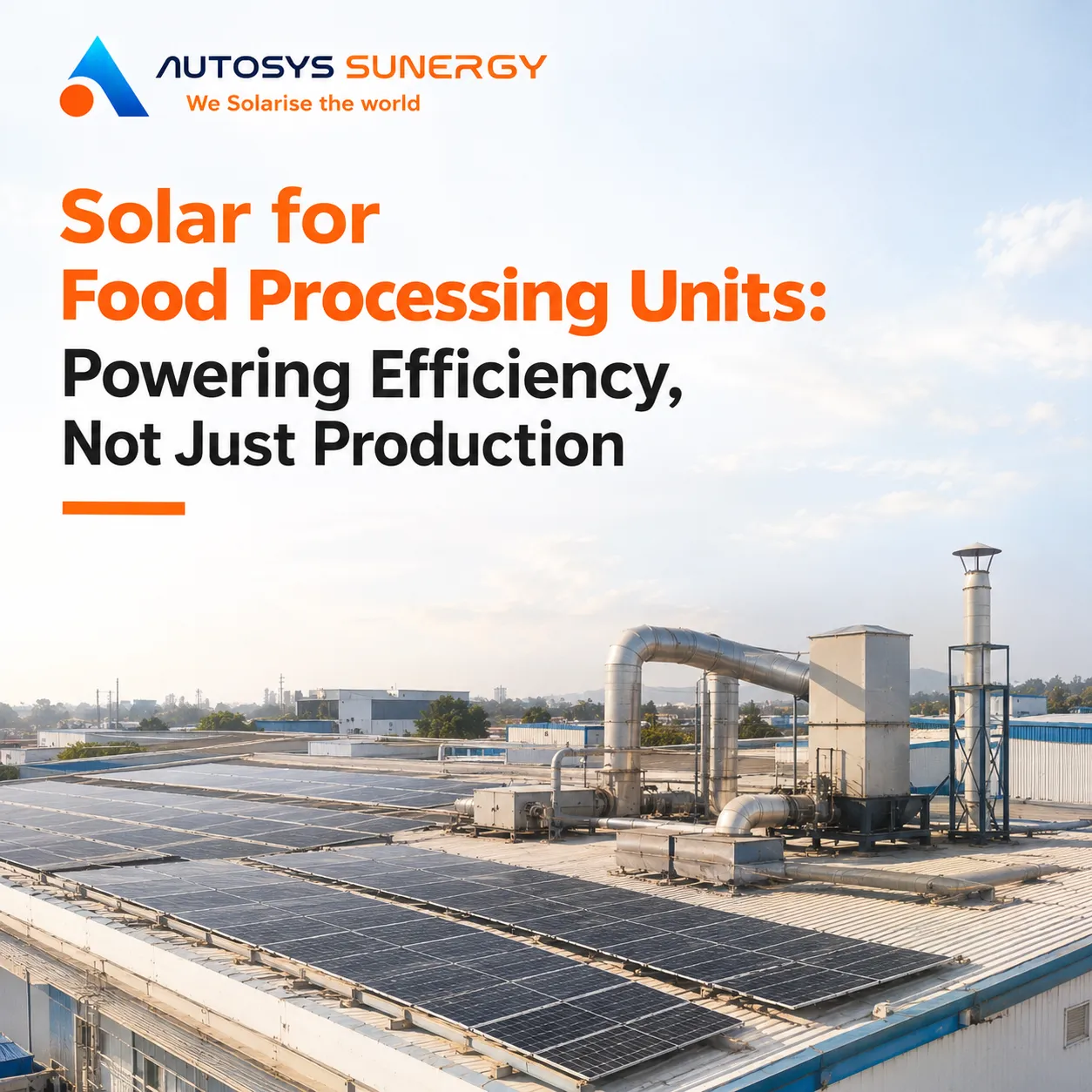
Solar for a food processing unit only reaches the electrical part of your energy bill. In a parboiled rice mill, process heat from husk or biomass can account for most of the plant’s energy use. In a spice-processing unit, electricity may represent a much larger share. The first question is not what a solar system costs — it is which type of plant you operate and how it consumes electricity.
The second question is your operating season. Madhya Pradesh’s net-metering settlement calendar generally runs from 1 October to 30 September. Whether that calendar works in your favour depends on when your mill operates, how much solar electricity it can consume directly and how surplus units are settled.
The key distinction: two rice mills on the same road can have very different solar economics. A raw rice mill and a parboiled rice mill may have similar roofs but very different electricity and process-heat requirements.
What Share of Your Bill Can Solar Actually Reach?
Food processing is a sector where energy and electricity are not interchangeable. Parboiling, drying, roasting, blanching, sterilising and solvent recovery may require substantial heat, often supplied by husk, briquettes, biomass or other fuels rather than grid electricity.
Solar PV generates electricity. It can offset suitable electrical loads, but it does not directly replace the thermal energy supplied to a boiler or process heater. The correct starting point is therefore your electricity bill, considered separately from your fuel expenditure.
- Raw rice mill: Milling equipment is primarily electrical, although the actual load depends on the process, capacity and auxiliary equipment. Solar may offset a large share of grid electricity if daytime consumption aligns with generation.
- Parboiled rice mill: Steam generation and drying may account for a substantial share of total process energy. Solar PV offsets the electrical loads, such as motors, conveyors and pumps, rather than the heat supplied by the boiler. The electrical share must be measured at the site instead of assumed.
- Spice and masala unit: Cleaning, grinding, pulverising, conveying and packaging can create substantial electrical demand. These operations may make a spice unit a strong solar candidate when the machines run during daylight.
- Dal and besan mill: Destoners, rollers, air classifiers, elevators and pneumatic conveying can be significant electrical loads. Conditioning and drying requirements vary by process, so separate electricity from thermal consumption.
- Oil and solvent extraction: Expellers, pumps and other equipment use electricity, while heating and solvent recovery can require substantial thermal energy. The proportion that solar can offset depends on the process design and energy balance.
- Fruit, vegetable and snack lines: Refrigeration, extrusion and packaging may be electrical, while blanching, frying and other heating stages can be thermal. The electrical share depends on the product and production line.
A common mistake is to calculate solar savings against the total energy spend instead of the electricity bill. If a plant purchases husk or biomass for process heat, that expenditure should not be counted as an electricity saving from rooftop solar.
Key takeaway: Before comparing proposals, separate electricity consumption from fuel consumption. For a parboiled rice mill, this distinction can materially change the expected savings and payback period.
Your Season Decides Everything: The 30 September Rule
The settlement calendar can affect a seasonal processor’s solar economics, but the result depends on its operating profile, tariff category and the applicable net-metering rules.
Madhya Pradesh’s net-metering regulations generally define the settlement period from 1 October to 30 September. Eligible surplus units can be carried forward within the settlement period, subject to the applicable regulations. At the end of the period, unadjusted credited units are settled according to the regulatory mechanism; they should not automatically be valued at the full retail electricity tariff.
Review the current MPERC tariff orders and the MPERC renewable-energy regulations before making a financial decision.
The LV-4.2 seasonal tariff may also be relevant to eligible seasonal industrial consumers. Its availability and conditions must be confirmed against the applicable tariff schedule and the unit’s actual connection category.
Consider two illustrative operating patterns:
If you process the kharif crop — for example, an oil mill crushing soybean mainly from October to March — much of the plant’s off-season may coincide with months of strong solar generation. If the site is largely shut during those months, the system may export a significant share of its generation. That surplus could remain unused until settlement unless the plant has sufficient daytime electrical loads or another permitted way to use the credits.
If you process the rabi crop — for example, a dal mill operating mainly from April to September — the operating season may overlap with stronger solar-generation months. This can improve direct self-consumption, depending on the shift pattern and the plant’s actual load. However, the months of operation alone do not guarantee a better return; generation, consumption and billing data must be modelled together.
For eligible LV-4.2 seasonal consumers, the published tariff schedule specifies off-season energy charges at 120% of the normal tariff. At a normal energy charge of ₹7.05 per unit, 120% is ₹8.46 per unit. The actual benefit of this provision depends on the consumer’s tariff eligibility, billing treatment and how the electricity is accounted for.
Key takeaway: Map the operating calendar against the October-to-September settlement period before deciding on solar capacity or a seasonal tariff declaration. Do not assume that every seasonal mill should declare a season or that every banked unit will be worth the full retail rate.
The Seasonal Tariff's Two Traps
If your unit is eligible for the seasonal tariff and you choose it, the declaration can come with conditions that materially affect the bill. The current tariff order should be reviewed before a declaration is made.
Under the LV-4.2 seasonal provisions, key conditions include:
- The consumption test. Monthly off-season consumption must remain within the prescribed limit, stated in the tariff schedule as 15% of the highest average monthly consumption across the preceding three seasons. Exceeding the limit in an off-season month can result in billing under the non-seasonal tariff for the year, as specified by the schedule.
- The demand test. Off-season maximum demand is subject to a limit linked to contract demand. The tariff schedule specifies a 30% operating limit and provides for non-seasonal billing if recorded demand in an off-season month exceeds 36% of contract demand.
- The declaration window. The tariff schedule prescribes a period for opting into the seasonal tariff. Confirm the applicable deadline and whether the declaration can be changed before submitting it.
- Off-season fixed charges. The schedule provides for charges based on 10% of contract demand or actual recorded demand, whichever is higher, subject to the applicable tariff terms.
There is also an important operational question for a solar-equipped unit: how will the discom apply the off-season consumption test when the plant has on-site generation and banked credits?
The wording of the tariff schedule and the way the discom calculates billed consumption need to be checked against the current regulations and the actual billing arrangement. Do not assume that gross meter imports, net billed units and the tariff’s defined consumption measure are interchangeable.
Before declaring a season with solar installed, obtain written clarification from your discom on how the consumption and demand tests will be applied to your connection. This is particularly important where a breach could result in retrospective non-seasonal billing.
In simple terms: The seasonal tariff may be valuable if your operating calendar and electricity profile fit its conditions. Confirm the billing interpretation in writing rather than relying on an assumption.
Solar for a Food Processing Unit Below 112 kW: Check the Connection Economics
The distinction between low-tension (LT) and high-tension (HT) supply can affect the cost of electricity and the value of solar generation. However, a plant should not choose or limit its connection solely to reach a particular solar payback.
Under the FY 2026–27 Madhya Pradesh tariff schedule, the LV-4 low-tension industrial category has an energy charge of ₹7.05 per unit for the applicable demand-based tariff. The HV-3.1 industrial tariff for supply at 11 kV has different energy charges depending on the load-factor band: ₹7.79 per unit up to a 50% load factor and ₹6.79 per unit for consumption in excess of that threshold.
These are tariff-schedule rates, not a guarantee that every solar-generated unit will displace electricity at the lower or higher rate. The actual effect depends on the monthly billing calculation, load factor, demand, self-consumption and applicable tariff terms.
The demand-charge comparison is also relevant:
- LV-4, urban: ₹336 per kW or ₹269 per kVA of billing demand.
- LV-4, rural: ₹221 per kW or ₹177 per kVA of billing demand.
- HV-3.1 at 11 kV: ₹409 per kVA of billing demand.
These charges are based on the applicable billing-demand rules. Solar generation does not automatically eliminate demand charges, and the precise bill impact depends on the consumer’s recorded demand and tariff conditions.
A site near the LT/HT connection boundary should therefore compare the full annual bill under each feasible connection arrangement. That comparison should include energy charges, demand charges, electrical infrastructure, power factor, load factor and the effect of solar self-consumption.
For a broader capacity comparison, review the 200kW plant costs and payback guide and, for larger sites, the 500kW solar plant economics guide.
One caution: improving power factor, selecting efficient drives and managing motor start-ups can improve electrical performance. However, deliberately restricting a genuine production expansion simply to remain below a connection threshold may be commercially counterproductive.
Key takeaway: If your sanctioned load or contract demand is near the LT/HT boundary, ask your EPC and electrical consultant to compare the full tariff and infrastructure costs before sizing the solar system. The applicable connection rules and your actual supply arrangement must be confirmed rather than inferred from a single kW figure.
Sizing: Your Working Calendar, Not Your Roof
Self-consumption depends on the overlap between solar generation and the plant’s operating hours. Two facilities with the same roof area and annual electricity consumption can have very different solar economics.
The following figures are illustrative modelling assumptions, not universal benchmarks. Your result must be calculated from interval load data, working days, shifts and expected solar generation.
- Single shift, approximately 9 a.m. to 5 p.m.: A daytime shift can support substantial direct consumption, but the actual share depends on the load during those hours and the plant’s operating days.
- Double shift, approximately 6 a.m. to 10 p.m.: A longer operating day may absorb more solar generation, especially if machinery runs at meaningful load through the central daylight hours.
- Seasonal operation with a genuine shutdown: The site may export a large share of annual generation during the off-season. This makes settlement terms and the operating calendar particularly important.
A proposal that models one working day and multiplies the result by 365 can overstate savings if it ignores shutdowns, weekly holidays, maintenance days and seasonal production.
Two practical ways to improve direct solar consumption are to schedule flexible loads during daylight and to size the system against the plant’s daytime baseload. Where operationally safe and feasible, activities such as grinding cycles, water pumping and compressed-air generation may be scheduled to make better use of solar output. Any change must remain compatible with process, safety and production requirements.
Do not size a system simply because the roof can accommodate it. A large mill shed may physically fit a bigger array than the plant can economically use. Start with the load profile and then assess available roof area using the solar panel space and roof-area guide.
In simple terms: Compare expected generation with annual consumption, but also model when the electricity is used. Exported units may not deliver the same financial value as electricity consumed directly behind the meter.
The Dust Problem Nobody Puts in a Proposal
Food-processing plants can generate dust and airborne residues. Rice mills may release husk particles, flour mills can produce starch dust, dal mills may produce pulse dust, and spice units can emit fine particles that settle on nearby surfaces.
When dust accumulates on solar modules, it can reduce light reaching the cells. The rate of soiling depends on the type of residue, wind direction, nearby exhausts, rainfall, dew, module tilt and cleaning practices.
For that reason, a generic soiling-loss assumption should not be accepted without a site assessment. A quarterly cleaning schedule may be insufficient for an array located downwind of a dusty exhaust, while a different location on the same property may need less frequent cleaning.
Two practical considerations should be included in the design:
- Array placement: Where the roof layout allows, assess whether the array can be positioned away from dust collectors, cyclones, vents and exhaust outlets. Wind direction and the discharge pattern should be considered rather than assuming one roof area is always cleaner than another.
- Cleaning and maintenance: Include a realistic cleaning plan and its cost in the operating model. The required frequency should be established from site conditions and adjusted using measured generation and inspection results.
Ask every bidder what soiling loss is included in the generation estimate. A proposal that gives a fixed percentage without examining nearby exhausts, dust sources and roof conditions may not reflect the site’s actual performance.
Key takeaway: Request the soiling assumption in writing and include cleaning responsibilities in the operations and maintenance (O&M) agreement. Actual performance data should be used to refine the cleaning schedule.
Roof Work Above a Live Food Line
For a food-processing facility, solar installation introduces both electrical and operational risks. The installation method must protect the roof, the production area and the product from contamination.
FSSAI’s hygiene requirements address the condition and maintenance of food-premises surfaces. The FSSAI licensing and registration regulations compendium is a useful reference, but the specific requirements applicable to your facility should be checked against the current rules and licence conditions.
On an RCC roof, drilling or other construction work above an operating production line can generate dust and debris. On a sheet roof, each fastener or penetration can affect weatherproofing and may create a route for water ingress or pest entry if it is not properly detailed and sealed.
Plan roof work in coordination with the plant’s maintenance, engineering and food-safety teams. The method statement should identify:
- The proposed work area and installation sequence.
- The production shutdown or isolation arrangements, where needed.
- Controls to prevent debris from entering the production area.
- The method for sealing roof penetrations.
- Access restrictions and worker-safety measures.
- Inspection and handover checks before production resumes.
Our industrial solar installation services should be assessed against the site’s production schedule, roof type and safety requirements rather than a generic installation timeline.
Asbestos roofs require special care. Do not drill, walk on or load asbestos-cement sheets without a competent assessment and a compliant method. Disturbing asbestos-containing material can release hazardous fibres. Roof replacement or a suitably engineered alternative should be evaluated with qualified professionals before any solar installation proceeds.
If you have spare land, consider a ground-mounted system. A ground-mounted array may avoid roof penetrations and reduce installation traffic over production areas. However, it is not automatically eligible for the same metering arrangement as a rooftop system. Confirm the applicable connectivity, metering, land, electrical and regulatory requirements with the discom before treating it as an alternative.
In simple terms: Ask for a written method statement that addresses production hygiene, roof integrity, worker safety and shutdown coordination. A proposal should explain how the work will be completed safely, not just how quickly the panels will be installed.
Solar for a Food Processing Unit: What the Numbers Look Like
The following examples are illustrative calculations, not guaranteed savings or quotations. Actual results depend on the final EPC price, measured load profile, tariff category, export treatment, operating calendar, soiling losses, maintenance costs and applicable taxes or duties.
Case one — an 80 kWp system on a spice unit
Assume a double-shift facility connected under the applicable low-tension industrial tariff.
- Illustrative capital cost: ₹50,000 per kWp, or ₹40 lakh.
- Illustrative annual generation: 120,000 units, assuming 1,500 units per kWp per year. Actual yield requires a site-specific assessment.
- Illustrative direct self-consumption: If 82% of generation is consumed directly, that equals 98,400 units.
- Avoided energy charges on those directly consumed units: At ₹7.05 per unit, the indicative value is approximately ₹6.94 lakh per year, before accounting for the actual billing calculation and other bill components.
- Illustrative annual operations and cleaning allowance: ₹0.44 lakh.
- Indicative net value from direct self-consumption: Approximately ₹6.50 lakh per year, before any value from exported electricity, taxes, financing and other adjustments.
- Simple payback on direct self-consumption alone: Approximately 6.2 years, using the assumptions above.
This calculation does not assign a retail-tariff value to exported units. Any additional benefit from surplus generation should be added only after confirming how those units will be adjusted or settled under the applicable metering arrangement.
Case two — a 300 kWp system on a continuous dal mill
Assume an HT industrial connection at 11 kV.
- Illustrative capital cost: ₹43,000 per kWp, or ₹1.29 crore.
- Illustrative annual generation: 450,000 units, assuming 1,500 units per kWp per year.
- Indicative energy-charge reference: The FY 2026–27 HV-3.1 tariff at 11 kV lists ₹7.79 per unit up to a 50% load factor and ₹6.79 per unit for consumption above that threshold.
- Potential value if all 450,000 generated units offset consumption at ₹6.79 per unit: Approximately ₹30.56 lakh per year. This is an upper-bound illustration, not a guaranteed saving; the actual result depends on the plant’s load factor, billing calculation and direct self-consumption.
- Illustrative annual operations allowance: ₹1.35 lakh.
- Indicative net value under that all-units-consumed assumption: Approximately ₹29.21 lakh per year, before other bill components, financing, taxes and any export adjustment.
- Simple payback under the same assumption: Approximately 4.4 years.
Demand charges are not assumed to disappear in either example. The actual savings should be calculated from the facility’s bills and consumption profile, including how the tariff’s load-factor bands apply after solar generation reduces grid imports.
These examples show why the tariff alone cannot determine the best system size. A larger plant may have a lower installed cost per kWp, but its financial performance still depends on the amount of electricity it can use and the value of any surplus.
Key takeaway: Do not include an assumed tax benefit as an immediate reduction in project cost unless the business’s tax position and eligibility have been checked by a qualified tax professional. Keep operating savings, export credits, financing and tax treatment separate in the payback model.
Choosing the EPC
Before signing a contract, verify five things:
- A separated energy analysis. The EPC should review electricity bills separately from fuel invoices and identify which loads solar can actually offset.
- A stated soiling assumption. The generation estimate should account for nearby exhausts, cyclones, dust collectors and cleaning requirements.
- A roof-work method statement. The proposal should address production hygiene, roof sealing, safety, access and any necessary shutdown.
- A connection and tariff assessment. The EPC should review the sanctioned load or contract demand, connection type, load factor and the tariff provisions applicable to your facility before recommending capacity.
- A seasonal tariff position. If the plant is seasonal, the proposal should explain whether LV-4.2 applies, how the operating calendar affects self-consumption and what confirmation is required from the discom.
Four red flags to watch for:
- A payback model based on total energy expenditure rather than the electricity bill.
- A generic soiling assumption without a site survey.
- Advice to declare a season without checking the current tariff conditions and the plant’s working months.
- A system capacity selected before anyone has assessed the load profile, roof condition and nearby dust sources.
The best EPC is transparent about what the system can and cannot deliver. A proposal for a parboiled rice mill should distinguish electricity savings from boiler-fuel costs. Our solar EPC services should begin with the site’s actual energy and electrical requirements, not simply the roof area.
In simple terms: Compare the assumptions behind each quotation, not just the price per kWp. Ask what proportion of your solar generation is expected to be consumed directly and how the model values exported units.
What This Looks Like in Western MP
The mandi belt around Indore, Dewas, Ratlam and Ujjain includes dal mills, besan units, spice processors, oil mills and other agricultural-processing facilities. Their solar requirements can differ substantially according to production schedules, electrical loads, roof construction and connection category.
Consider a mid-sized spice unit in Indore that runs a double shift during its busy season. Grinding and conveying may create significant daytime demand, while cyclones and dust collectors occupy portions of the shed roof. Its suitable solar capacity depends on the electrical load that can absorb generation, the roof area that is actually usable and the expected export treatment.
Autosys Solar has listed on-grid installations across the sector, including Pushp Masale, Indore — 225 kW; S.R. Agro, Ratlam — 120 kW; Star Trading, Ratlam — 100 kW; and Sun Rise Food — 60 kW. These project examples provide context, but the performance and economics of any new project should be evaluated from its own operating data.
Our industrial solar installation projects in Indore and the commercial solar ROI guide can help plant owners compare project considerations and investment assumptions.
Key takeaway: Ask prospective bidders about comparable food-processing installations, roof-work coordination and measured generation performance. Where possible, review operating data from a facility with similar loads and dust conditions rather than relying solely on a projected model.
Frequently Asked Questions
Will solar eliminate my factory's energy bill?
No. Solar PV generates electricity and can offset eligible grid consumption. If your process relies on husk, briquettes, biomass or another fuel for heat, that thermal-energy expenditure is not automatically reduced by installing solar panels. Solar can offset suitable electrical loads such as motors, grinders, conveyors, pumps, refrigeration and packaging equipment.
How much of a rice mill's energy can solar reach?
It depends on the mill’s process and electricity profile. A raw rice mill may have a predominantly electrical process, while a parboiled mill can use substantial thermal energy for steam and drying. Calculate the share from the actual electricity and fuel records rather than applying a universal percentage.
Should I declare a season under LV-4.2 if I install solar?
It depends on the applicable tariff conditions, your operating months and the way your surplus generation is used or settled. A mill operating mainly from April to September may have a different profile from one operating from October to March. Model generation and consumption across the full settlement period, then confirm the declaration requirements with the discom.
What happens if I exceed the off-season limits?
The LV-4.2 schedule specifies conditions relating to off-season consumption and maximum demand. Exceeding a prescribed limit can trigger billing under the non-seasonal tariff for the year, as set out in the schedule. Check the current order and your applicable tariff category before relying on a particular limit.
Does drawing my own banked solar count against the 15% limit?
Do not assume that gross meter imports, net billed units and the tariff’s defined consumption measure are treated identically. The applicable tariff wording and discom billing practice need to be checked for a solar-equipped seasonal consumer. Obtain written clarification before declaring a season if the interpretation could materially affect your bill.
My mill is near 110 kW. Should I move to high tension?
Not for solar alone. Compare the applicable LT and HT energy charges, demand charges, connection requirements, electrical infrastructure costs and your actual load profile. Solar does not automatically remove demand charges, and the HT load-factor bands can affect the energy-charge calculation. Have the full bill modelled before deciding.
How often will the panels need cleaning?
The required frequency depends on dust levels, the type of residue, wind direction, rainfall, module tilt and array location. Food-processing sites with dusty exhausts may require more frequent inspection and cleaning than a typical office rooftop. Start with a site-specific maintenance plan and adjust it using measured performance.
We have an asbestos roof. Can we install solar?
Do not proceed with drilling or loading an asbestos-cement roof without a competent, compliant assessment. Disturbing asbestos-containing material can release hazardous fibres. Roof replacement or a properly engineered alternative, such as a suitable ground-mounted system where permitted, should be assessed by qualified professionals.
Can we claim the ₹2 per unit captive generation rebate?
Do not assume that your plant qualifies for a captive-generation rebate simply because it uses biomass or operates its own equipment. Eligibility depends on the specific scheme or tariff provision, the type of generation and the applicable conditions. Confirm the current rule and your plant’s facts with the discom or a qualified energy adviser before including any rebate in a financial model.
Is a ground-mounted system on our own land eligible for net metering?
Not automatically. Eligibility depends on the applicable regulations, connection and metering arrangements, premises requirements and discom approval. Ask the discom to confirm the proposed configuration in writing before treating a ground-mounted array as equivalent to a rooftop system.
Start With Your Bill Split, Not a Quotation
The expensive mistake in food processing is not necessarily buying the wrong panel. It is choosing a system based on the wrong electricity baseline, overlooking the operating calendar, assuming surplus units are worth the retail tariff or ignoring dust and roof constraints.
Such a system can still generate electricity, but the actual savings may be lower than the proposal promises.
A proper assessment should establish five things before a price is finalised:
- Your electricity bill, separated from fuel expenditure.
- Your sanctioned load or contract demand, connection category and applicable tariff.
- Your production season mapped against the net-metering settlement period.
- A roof and dust-source assessment, including structural and hygiene constraints.
- A solar capacity based on the facility’s load profile, expected self-consumption and the applicable treatment of exported units.
If you run a dal mill, flour mill, spice unit, oil mill or agricultural-processing line in Indore, Dewas, Ratlam, Ujjain or elsewhere in western Madhya Pradesh, request an assessment before committing to a system size. The solar power plant cost per MW in Madhya Pradesh guide provides a capacity-cost reference, but it cannot establish how much of your electricity bill a particular system will offset.
Keywords