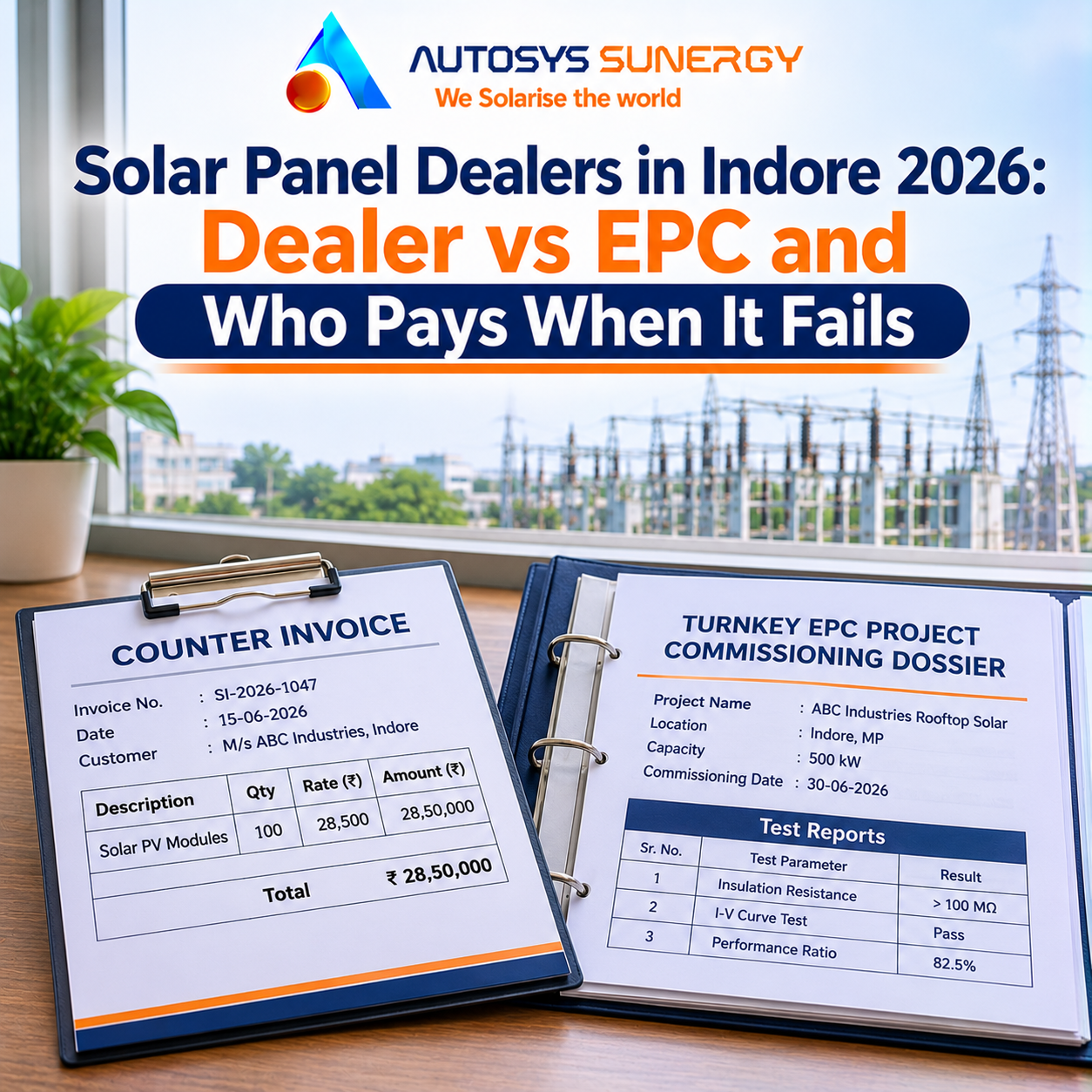
Direct answer: solar panel dealers in Indore primarily sell equipment; a turnkey EPC contractor takes responsibility for a defined package of design, supply, installation, testing and commissioning. Buying components separately and hiring an electrician can appear cheaper, but the final cost depends on GST classification, subsidy eligibility, installation quality, documentation and who accepts contractual responsibility if something goes wrong.
The dealer's quote may look cheaper because it may cover a different scope of work. What is missing is not necessarily just a contractor's margin. It may include system design, structural assessment, installation, testing, commissioning, grid-connection support and after-sales responsibility.
That does not mean a dealer is the wrong choice in every situation. A replacement module, an out-of-warranty inverter, protection spares, or equipment for a factory that already has its own qualified electrical team may be sensible dealer purchases.
In simple terms: buy individual components from a dealer when you can manage their selection, installation and testing. Buy a complete plant from an EPC contractor when you need one party to coordinate and deliver the complete project.
What a dealer sells, and what an EPC sells
Direct answer: a dealer generally sells goods, while an EPC contractor supplies an agreed combination of equipment and services. The legal and commercial obligations depend on the actual contract, not simply on the label used by the business.
The five kinds of business an Indore buyer may encounter:
- Component dealer or trading counter — sells modules, inverters, structures, cables and electrical accessories. Installation and performance responsibilities depend on what the dealer separately agrees to provide.
- Authorised brand dealer or channel partner — sells equipment through an authorised sales channel and may provide installation referrals or additional services.
- Electrical contractor on labour rates — installs equipment supplied by the customer or another seller. The scope may cover workmanship without covering equipment selection, system design or long-term performance.
- Turnkey EPC contractor — undertakes an agreed package of engineering, procurement, installation, testing and commissioning, with responsibilities defined in the contract.
- Aggregator or lead platform — introduces customers to contractors or suppliers. The platform may not itself execute or warrant the installation.
The important difference is the contractual scope. A properly drafted EPC agreement can give the customer one principal contractor responsible for the agreed design, supply and execution obligations. A split purchase can involve several parties, so the customer must understand which party is responsible for each part.
A dealer can also provide installation through a separate contractor. In that case, the buyer should identify the actual executing contractor and obtain written confirmation of the division of responsibility.
The best solar company is defined by what it undertakes in writing, not simply by what it stocks.
Key takeaway: Ask what the vendor is contractually promising. If the answer is only that the panels are genuine, you are buying equipment rather than a complete commissioned plant.
What a dealer legally cannot do in Madhya Pradesh
Direct answer: a trading dealer does not automatically become an authorised electrical contractor simply because it sells solar equipment. Electrical installation, testing and documentation must comply with the applicable Central Electricity Authority regulations, state licensing requirements and Madhya Pradesh Electricity Supply Code.
The relevant national framework includes the Central Electricity Authority (Measures relating to Safety and Electric Supply) Regulations, 2023. These regulations establish electrical-safety responsibilities and requirements for testing consumer installations. The CEA has also published subsequent amendments, so the current consolidated requirements should be checked before a project is executed.
Under the CEA framework, testing results submitted for a consumer installation must meet the applicable requirements, including the prescribed involvement of a licensed electrical contractor where required. The precise requirements depend on the installation and the applicable rules.
Madhya Pradesh's Electricity Supply Code also sets out the process for consumer installation testing and inspection. Regulation 6.23 addresses the presence of the licensed electrical contractor or a technically qualified representative during the distribution licensee's inspection. The current Supply Code and amendments are available through the MPERC Supply Code page.
There is an important distinction between helping with an application and executing electrical work. A dealer may help a customer understand or prepare a net-metering application. That does not make the dealer the licensed executing contractor or authorise it to sign documents that require a qualified or licensed person.
A dealer may also arrange a separate licensed contractor. That arrangement should be transparent: the customer should know who is carrying out the work, who is supervising it and who is signing the relevant test documents.
A contractor's signature should represent actual responsibility and appropriate testing, not simply be paperwork obtained for a fee.
In simple terms: check the executing contractor's licence and the applicable testing requirements. A dealer's sales invoice is not a substitute for an installation test report or commissioning documentation.
The tax arithmetic that can change the price gap
Direct answer: a qualifying solar EPC/composite supply may use the 70:30 valuation method, resulting in an effective GST rate of 8.90% when the goods portion attracts 5% and the service portion attracts 18%. Separate purchases can have a different tax outcome, but 11.89% is an illustrative calculation, not a universal rate for every split purchase.
The 70:30 valuation approach was introduced for specified solar power generating system supplies where goods and services are supplied together under the relevant contract. Under this method:
- 70% of the qualifying aggregate contract value is treated as the value of goods attracting the applicable 5% rate.
- The remaining 30% is treated as the value of taxable services attracting 18%.
The calculation is:
- Goods: 70% × 5% = 3.50%
- Services: 30% × 18% = 5.40%
- Effective GST: 8.90%
The GST rate on specified renewable-energy devices and parts was rationalised from 12% to 5% with effect from 22 September 2025. The government's announcement is available in the PIB release on renewable-energy GST changes.
However, the 70:30 method should not be assumed for every invoice that mentions solar equipment. The actual supply, contract structure, classification and applicable GST notifications must be examined.
For a separate purchase, individual items may attract different rates according to their classification and use. For example:
- Solar PV modules — specified solar modules generally fall under the applicable 5% renewable-energy goods rate.
- Standalone inverter — commonly classified under heading 8504, with the applicable rate depending on the exact product classification.
- Mounting structure, cable, switchgear and earthing materials — rates depend on the relevant tariff classification and product.
- Installation labour — generally subject to the applicable service GST rate when supplied as a taxable service.
The draft's 11.89% example assumes that modules make up 47% of the pre-tax purchase value at 5%, while the remaining 53% attracts 18%.
That calculation is:
47% × 5% + 53% × 18% = 11.89%
This is a worked example, not a standard GST rate for every independently purchased solar system. Actual invoices can have different item values, classifications and tax treatments.
For illustration, on an identical pre-tax base of ₹2,50,000:
- At 8.90% GST, tax is ₹22,250.
- At 11.89% GST, tax is ₹29,725.
- Difference: ₹7,475, or approximately ₹1.50 per watt on a 5,000 W system.
Our 5 kW price guide for Indore explains the other cost elements buyers should compare.
Key takeaway: compare the GST treatment on the actual quotations, not just the headline percentage. Ask for item-wise taxable values, HSN/SAC classification and the contractual basis for any 70:30 valuation.
The ₹78,000 you may be eligible to claim
Direct answer: eligible residential consumers can receive up to ₹78,000 in central financial assistance under PM Surya Ghar, subject to scheme conditions. The scheme requires the installation to follow its National Portal and registered-vendor process. A separate retail purchase followed by an independently arranged installation should not be assumed to qualify.
The PM Surya Ghar: Muft Bijli Yojana is intended for eligible residential consumers with grid-connected rooftop solar systems. Under the standard CFA structure for eligible states, the assistance is calculated as follows:
- First 2 kW — 60% of the applicable benchmark cost.
- Additional 1 kW — 40% of the applicable benchmark cost.
- Maximum standard CFA — ₹78,000 for eligible residential consumers in general states, subject to the scheme's conditions and capacity limits.
The scheme's operational guidelines explain the eligible consumer category, registered-vendor process, technical requirements and vendor obligations.
The registered-vendor process is important. The scheme requires consumers to select a registered vendor through the National Portal and follow the prescribed installation and commissioning process. The vendor has responsibilities relating to system quality, technical documentation, commissioning and operation and maintenance.
Three conditions deserve particular attention:
- Registered-vendor process — the eligible installation must be completed through the scheme's prescribed portal and vendor process. A normal retail purchase does not automatically satisfy this requirement.
- Domestic-content requirements — eligible modules must meet the applicable domestic-content requirements. The buyer should verify the module and cell compliance documents rather than relying on a verbal assurance.
- Vendor maintenance obligations — the scheme's registered-vendor framework includes a five-year comprehensive maintenance obligation, subject to the applicable guidelines and agreement.
The DCR condition is important because a module can be legally sold in the open market but still fail to meet the requirements for a subsidised installation. The buyer should check the exact module and cell documentation before accepting a quotation.
Madhya Pradesh also has state-level electricity and net-metering requirements. The relevant MPERC regulations and amendments should be checked for the consumer's connection category and application date. The MPERC regulation index provides access to the current regulations and amendments.
Our note on rooftop solar subsidy in Indore covers the residential subsidy process.
In simple terms: do not compare a dealer quotation with a subsidised EPC quotation until you have confirmed whether both include the same equipment, eligible modules, portal process, installation, commissioning and maintenance obligations.
What a warranty claim actually requires
Direct answer: a module or inverter warranty is governed by the manufacturer's warranty statement and its conditions. A purchase invoice alone may not be enough to establish a claim. Serial numbers, installation records, test results and maintenance documents can all be important.
This is one of the most important parts of the dealer-versus-EPC decision. The buyer should understand what evidence the manufacturer may request if a product develops a defect.
Waaree provides a useful example. Its published module warranty statement requires written notification within 30 days after discovery of a defect. Its claim documentation includes:
- Invoice copy with corresponding module serial numbers
- Module type and purchase order
- Installation agreement
- Installation test report conforming to IEC 62446 or IEC 60364-6
- Periodical maintenance reports
- Site handover and grid-connection acceptance information
- Installation address, where different from the buyer's address
The applicable requirements are set out in Waaree's module warranty statement. Buyers should always check the current warranty version for their exact module model and purchase date.
For a low-output claim, manufacturers may also ask for system layout information, photographs of the installation, shading details, monitoring records or additional test results. The exact evidence depends on the manufacturer's procedure and the nature of the claim.
Inverter manufacturers also impose installation and operating conditions. For example, Fronius's terms and conditions address installation quality, compliance with relevant standards and other warranty exclusions. The buyer should not assume that every inverter brand has identical requirements.
The practical lesson is not that every dealer-sold product automatically loses its warranty. A dealer can provide a valid invoice and serial-number information, and the manufacturer may accept a claim where the installation complies with its requirements. The risk arises when the buyer cannot produce the necessary records or when installation conditions breach the warranty terms.
A reliable solar company provides the equipment records, installation test documents and handover file at commissioning, so the customer is not trying to reconstruct them years later.
Key takeaway: the manufacturer decides the product-warranty claim under its terms. The installer and project contractor help create the installation evidence needed to support that claim.
Who pays when the roof underperforms
Direct answer: responsibility depends on the cause of the fault, the contract, the equipment warranty and the evidence available. A dealer, installer, EPC contractor, manufacturer or distribution company may be responsible for different parts of the problem.
Consider these common installation and performance issues:
- Shading not modelled — responsibility may rest with the designer or EPC contractor if the agreed scope included a site survey and shading assessment.
- Unequal string lengths — responsibility depends on the system design and who selected or approved the string configuration.
- Undersized DC cable — the designer or installer may be responsible if the installed cable does not comply with the approved design or applicable electrical requirements.
- Incompatible connectors — responsibility may rest with the installer if incompatible products were mated contrary to manufacturer instructions or applicable standards.
- Bad crimps — generally a workmanship issue, subject to the contract and the evidence of who performed the work.
- Incorrect inverter commissioning settings — responsibility depends on who configured the inverter and whether the settings comply with the approved design and grid requirements.
- Inadequate earthing — a serious electrical-safety issue that must be investigated and corrected by a qualified professional.
These examples show why the contract matters. Equipment defects, installation defects and grid-related problems are different categories. A manufacturer may consider a product warranty claim, while an installer may be responsible for workmanship under the installation agreement.
A split purchase does not automatically leave every fault without a responsible party. However, it can make responsibility harder to establish if the dealer, electrician and equipment manufacturer each point to another party.
In simple terms: buying hardware alone does not mean the hardware is the only thing that can go wrong. Make sure every installation task has an identified, qualified and contractually accountable party.
The connector case, in detail
Direct answer: mating DC connectors from different manufacturers without verified compatibility can create electrical and safety risks. Similar appearance or a shared connector style does not prove that two products are compatible.
PV connectors are designed and tested as specific connector systems. Their mechanical dimensions, contact design, materials, seals and electrical characteristics must work together.
The relevant standards and manufacturer instructions should be checked for the exact connector models used. IEC 62852 addresses safety requirements and tests for DC connectors used in photovoltaic systems. IEC 62548 and IEC 60364-7-712 also address PV system design and electrical installation requirements.
Stäubli's product-liability statement explains the manufacturer's position on cross-connection and the risks of connecting products that have not been verified as compatible.
Consider a possible Indore installation scenario. A dealer supplies modules with factory-fitted Brand A leads and separately supplies generic Brand B connectors for the string cables.
Neither product has to be defective for a problem to occur. Each connector may comply with its own product specification when used with the matching connector system. The risk arises when two products are mated without verified compatibility.
A competent installer should check the connector manufacturer and model, follow the module manufacturer's installation instructions and use the specified crimping tools and procedures. The installer should not assume that two products are compatible merely because they look alike.
The dealer may have responsibility if it made a misleading compatibility representation or supplied a product contrary to the agreed specification. The installer may have responsibility if it selected or mated incompatible products during installation. The facts and contract determine the outcome.
A poor connection can create contact resistance and localised heating. The resulting voltage drop may be too small to stand out on a generation dashboard, while the concentrated heat can still create a safety risk.
Key takeaway: check connector compatibility before installation. Keep the product details and installation records, and have any suspected connector problem inspected by a qualified professional.
What consumer law gives you — and takes away
Direct answer: the Consumer Protection Act, 2019 may provide remedies for eligible consumers where goods are defective, services are deficient or an unfair trade practice has occurred. Whether a buyer qualifies as a consumer depends on the facts, including the purpose of the purchase.
For a residential buyer who qualifies as a consumer, a complaint may involve defective goods, deficiency in installation services or misleading representations. Depending on the evidence and applicable law, a Consumer Commission may order remedies such as repair, replacement, refund, compensation or costs.
When equipment and installation are purchased separately, the buyer may have to establish which party was responsible for the particular defect or service failure. That can make the dispute more complicated, but it does not automatically remove the buyer's legal rights against a seller or service provider.
There are two important legal points to understand:
- Commercial purpose: Section 2(7) of the Consumer Protection Act excludes purchases for resale or commercial purposes from the definition of a consumer, subject to the statutory exception for goods used exclusively to earn a livelihood through self-employment.
- Limitation period: Section 69 generally requires a consumer complaint to be filed within two years from the date on which the cause of action arises, subject to the Commission's power to condone delay for sufficient cause.
The financial limits for Consumer Commission jurisdiction are also important. Under the Consumer Protection (Jurisdiction of the District Commission, the State Commission and the National Commission) Rules, 2021:
- District Commission — consideration paid does not exceed ₹50 lakh.
- State Commission — consideration paid exceeds ₹50 lakh but does not exceed ₹2 crore.
- National Commission — consideration paid exceeds ₹2 crore.
These limits relate to the value of goods or services paid as consideration, not simply the compensation a complainant hopes to receive. The official notification is available in the Gazette of India.
For factories, hotels, hospitals and companies, the commercial-purpose exclusion may be relevant. However, the position depends on the buyer's legal status, the nature of the purchase and the use of the system. The self-employment exception should not be treated as an automatic exemption for every small business.
Our guide to commercial solar in Indore explains why business buyers should pay particular attention to contractual scope, warranties and project documentation.
In simple terms: consumer protection depends on the buyer's legal status and the facts of the transaction. A clear written contract and traceable installation records make disputes easier to assess.
The 25-year survivorship question
Direct answer: solar modules may carry long performance warranties, while inverters and other components can have shorter product warranties. Warranty duration varies by brand, model, product generation and the terms in force at the time of purchase.
The real question is not simply which supplier is most likely to remain in business. It is whether the customer will still have the records, product details and warranty information needed to obtain support if the original installer or dealer is no longer operating.
A buyer should retain:
- Original tax invoices and purchase orders
- Module serial numbers and inverter model and serial numbers
- Module and inverter warranty certificates
- Approved system layout and single-line diagram
- Structural drawings and relevant design documents
- Installation test reports and commissioning records
- Grid-connection and net-metering documents, where applicable
- Monitoring portal credentials and generation records
- Maintenance and repair history
A manufacturer may remain available after the original dealer or EPC contractor has closed, but that does not guarantee a successful warranty claim. The manufacturer's terms, product identification and evidence requirements still apply.
Do not rely on unsupported market claims about how many installers will survive or how many systems lenders finance. A customer's protection should be based on contract terms, documentation and the manufacturer's published warranty conditions.
Key takeaway: no dealer or EPC contractor can guarantee that it will operate for the entire life of a solar plant. Judge the provider by the quality of the documentation it hands over and the clarity of its contractual obligations.
What your insurer does after a fire
Direct answer: insurance coverage for rooftop solar depends on the policy wording, the property insured, the declared sum insured and the insurer's conditions. Do not assume that every standard home or commercial policy automatically covers every solar installation.
For a residential property, some versions of Bharat Griha Raksha include solar panels among additional structures attached to the home building. However, the actual policy schedule, wording, exclusions and declarations must be checked. The Bharat Griha Raksha policy wording is one example, not a substitute for the wording issued by your own insurer.
For a commercial property, the owner should check whether the rooftop solar plant is included in the insured property and whether the declared value reflects its replacement cost. The treatment of the panels, inverter, mounting structure and associated equipment may depend on the policy's definition of buildings, plant and machinery or other insured property.
A useful case to understand the importance of insurance declarations is the Dhule cold-storage fire dispute. In that matter, the insurer raised issues that included the installation of solar panels without intimation. The Maharashtra State Commission's decision was reported by the Free Press Journal.
That case should not be read as a rule that every insurer can reject a claim whenever a solar plant is installed without a contractor's certificate. Insurance decisions depend on the specific policy, disclosures, evidence, cause of loss and applicable law.
The practical steps are straightforward:
- Inform your insurer about the solar installation.
- Obtain written confirmation of how the panels and associated equipment are covered.
- Check whether the sum insured includes the replacement value of the system.
- Keep invoices, commissioning documents, photographs and maintenance records.
- Follow the policy's safety, inspection and disclosure requirements.
In simple terms: tell your insurer about the solar plant and obtain written confirmation of the cover. Do not rely on an assumption that rooftop equipment is automatically included.
When a dealer is the right choice
Direct answer: a dealer is often the right choice when you are purchasing individual components or already have the technical and contractual capability to manage installation. A registered-vendor or turnkey arrangement may be more suitable when you need a complete grid-connected, subsidy-eligible residential plant.
Consider these six conditions:
- Subsidy — If you want to claim PM Surya Ghar CFA, follow the registered-vendor and National Portal process. A normal retail purchase should not be assumed to qualify.
- Grid connection — For a standalone system with no grid interconnection, a dealer may be suitable if the buyer arranges compliant design and installation. A grid-connected plant also needs to meet the relevant DISCOM and regulatory requirements.
- In-house staff — A dealer may be suitable if you employ qualified electrical professionals who can design, install, test and maintain the system. This is relevant to some industrial installations in Indore.
- Scope — A dealer is useful for spares, replacement modules and individual inverter purchases. For a complete plant, compare the dealer's full delivered cost with an EPC quotation, including taxes and services.
- Structural work — A replacement on an existing, verified structure may be a straightforward component purchase. Elevated frames, older slabs and sheet roofs may require structural and wind-load assessment.
- Financing — If you need a project loan, check the lender's requirements for the contractor, invoice, installation and commissioning documents. Do not assume every lender requires the same EPC arrangement.
Several aftermarket purchases can make sense through a dealer even when the original plant was built by an EPC contractor:
- A single replacement module after impact damage
- An out-of-warranty inverter replacement
- Protection spares such as string fuses and surge-protection devices
- Genuine, compatible DC connectors
Two precautions matter. First, match a replacement module's electrical characteristics and technology to the existing string and inverter design. Second, check connector compatibility with the existing module leads before installation.
Also compare the tax treatment of a standalone inverter purchase with the tax treatment under a qualifying EPC contract. For example, if a replacement inverter has a pre-tax value of ₹42,500 and attracts 18% GST, the tax is ₹7,650. A different tax outcome under a qualifying EPC contract depends on the contract's actual scope and applicable valuation rules. The two transactions should not be treated as identical supplies.
Key takeaway: the dealer channel is not inherently inferior. It is a component-purchase route. Use it when you can manage the design, installation, testing and documentation that are not included in the dealer's quotation.
Already bought from a dealer? Close the gaps now
Direct answer: a working solar array does not automatically need to be dismantled because it was purchased through a dealer. The priority is to document what was installed, inspect the electrical work and correct any safety or compliance issues.
Take these steps while the dealer and installer still have access to the purchase and installation records:
- Get a serial-number annexure from the dealer, listing each module barcode and the inverter's make, model and serial number. Reconcile it with the original invoice.
- Register the inverter in your own name on the manufacturer's monitoring portal, where supported. Keep the datalogger connected and retain generation records.
- Arrange an installation audit through a qualified and appropriately licensed electrical contractor. The inspection should cover string voltages and currents, polarity, insulation resistance, earthing, bonding, protective devices and connector compatibility, as applicable.
- Inspect DC connectors and have any incompatible or poorly installed connections corrected using the specified connector system and manufacturer-approved tools.
- Photograph the installation — module barcodes, equipment nameplates, DCDB internals, earthing arrangements, mounting fasteners and the overall rooftop layout.
- Start a maintenance log recording cleaning dates, inspections, repairs, generation readings and any inverter alarms.
- Inform your insurer about the solar plant and obtain written confirmation of the coverage and sum insured.
- Keep grid-connection records — retain the relevant application, inspection, approval and meter documents for a grid-connected system.
An independent inspection cannot recreate every original commissioning record. However, it can document the plant's present condition, identify defects and provide a useful baseline for future maintenance and warranty discussions.
In simple terms: you may not be able to recreate the original commissioning process retrospectively, but you can create an accurate as-built record and correct problems before they become serious.
Frequently asked questions
Are solar panels cheaper from a dealer in Indore? The equipment quotation may be cheaper because it covers only hardware. Compare the final cost after installation, electrical protection, structure, testing, commissioning, applicable GST and maintenance. The cheapest equipment quote is not automatically the cheapest completed plant.
Can I claim the subsidy if I buy panels myself? Do not assume that a self-purchased system will qualify. PM Surya Ghar requires the prescribed National Portal and registered-vendor process, eligible equipment and compliance with the scheme guidelines. Confirm the exact arrangement with the registered vendor and current scheme rules before paying for equipment.
Is the warranty the same wherever I buy? The manufacturer's warranty is governed by its published terms, but the evidence needed for a claim can vary. Keep the invoice, serial numbers, installation records, test reports and maintenance documents. Check whether the particular product has channel, installation or registration conditions.
Can a dealer file my net-metering application? A dealer may help the customer prepare or submit information where the process permits it. That does not automatically authorise the dealer to execute electrical work or sign documents that require a licensed contractor or other qualified person. The actual responsibilities depend on the applicable MPERC and DISCOM requirements.
I run a shop. Am I covered by consumer law? It depends on the purpose of the purchase and the facts. The Consumer Protection Act excludes purchases for commercial purposes, subject to the statutory self-employment livelihood exception. A small business does not automatically qualify for that exception.
What single document should I insist on? There is no single document that replaces the complete project file. Ask for the installation test and commissioning report, module serial-number list, inverter details, system layout, warranty documents and grid-connection records where applicable. Our solar price guide for Indore can help you compare the equipment and project scope.
Before you buy
The dealer-versus-EPC decision is not simply about trust or price. It is about which party is responsible for each part of the project, from equipment selection and installation to testing, grid connection, warranty support and maintenance.
If you employ qualified electrical staff who can design the array, arrange compliant installation, complete testing and maintain the records, a dealer can be an efficient way to buy hardware. If you do not have that capability, a complete EPC arrangement may reduce coordination gaps and make responsibilities clearer.
A reliable solar company always explains where its responsibility begins and ends, and puts that boundary in the contract rather than leaving it to a conversation.
If you are comparing a dealer quotation with a turnkey proposal in Indore, put both documents side by side. Check who is responsible for design, equipment supply, structural assessment, electrical installation, test reports, DISCOM coordination, subsidy documentation, warranty assistance and future maintenance.
We can review those responsibilities against your two quotations as part of scoping our solar installation services, including the components that may genuinely be better value when purchased separately.
Key takeaway: ask both vendors one question — who is the executing contractor, what work are they responsible for, and what licence or qualification applies to that work? The answer tells you what you are actually buying.
Keywords