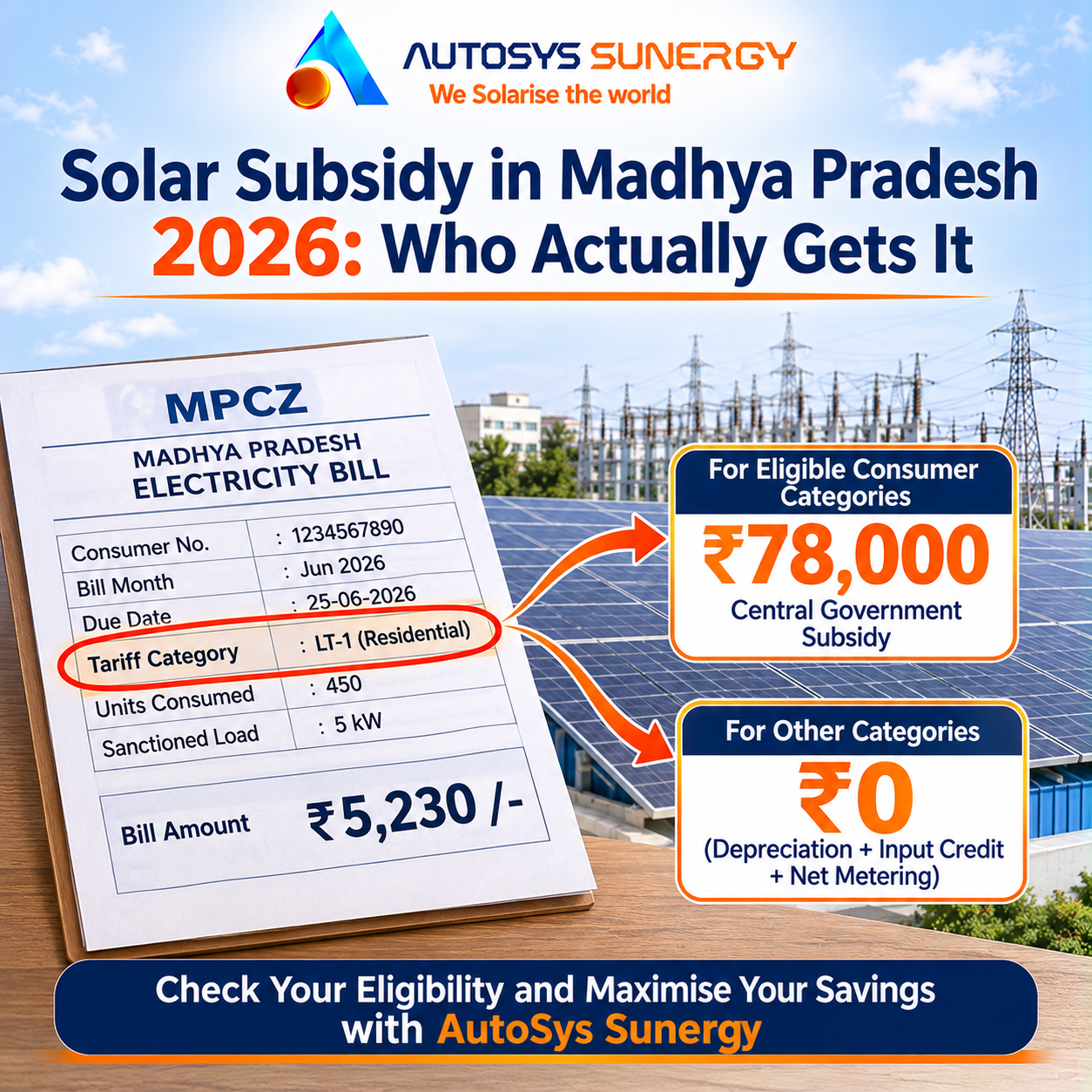
Shops, factories, offices, schools and hospitals do not qualify for the residential Central Financial Assistance (CFA) under PM Surya Ghar: Muft Bijli Yojana. The widely quoted ₹78,000 benefit is the maximum central subsidy for eligible residential rooftop solar installations. Madhya Pradesh's FY 2026–27 tariff order does not establish an additional state-level household cash top-up.
The important distinction is that the building's appearance does not decide eligibility on its own. The electricity connection, consumer category, scheme conditions and the actual use of the premises all matter.
The subsidy is linked to an eligible residential electricity connection, not simply to ownership of a house. A property on a commercial connection cannot claim residential CFA merely because someone lives upstairs. Equally, a tariff category marked domestic does not automatically prove that every type of institution or premises qualifies under the central residential scheme.
Key takeaway: check the tariff category and consumer details on your latest electricity bill before approaching an installer. LV-1 is the domestic tariff category in Madhya Pradesh's FY 2026–27 schedule. LV-2, LV-4, LV-5 and the relevant high-voltage categories are non-domestic, industrial or agricultural categories. However, tariff classification is only the first check, not a final subsidy approval.
The two-layer eligibility test
Direct answer: eligibility requires two separate checks. First, the electricity connection must fall within the residential segment covered by the scheme. Second, the proposed installation must meet the scheme's technical, documentation and verification requirements.
The PM Surya Ghar operational guidelines make the distinction clear:
- The scheme's residential CFA is intended for eligible residential consumers and their rooftop solar installations.
- The guidelines exclude non-residential consumer segments, including government, commercial and industrial consumers.
- Commercial and industrial consumers cannot claim the residential CFA simply because they install solar panels on a building.
- The National Portal uses the consumer's electricity-account details to process the application and connect it with the relevant DISCOM.
These conditions are set out in the PM Surya Ghar implementation guidelines. Read the scheme document rather than relying only on a salesperson's interpretation.
The second check is equally important. A domestic tariff classification does not remove the need to comply with scheme requirements, obtain the necessary DISCOM approvals and complete commissioning and verification. If the premises' actual use does not match the category or the application details, the consumer should resolve the discrepancy with the DISCOM before proceeding.
Key takeaway: an eligible residential connection is essential, but it is not a guarantee of payment. The installation and application must also satisfy the scheme's conditions.
What a household actually gets
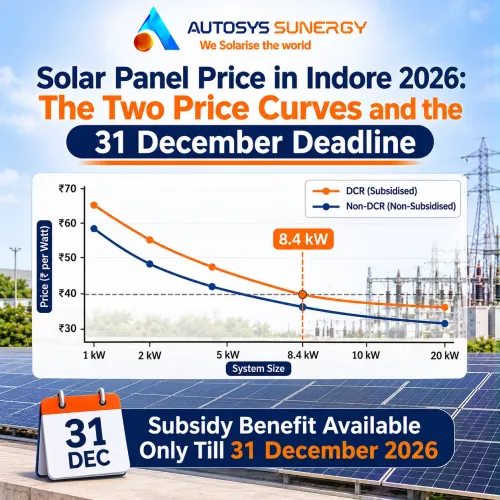
Direct answer: the central CFA is ₹30,000 per kW for the first 2 kW and ₹18,000 for the next 1 kW. No additional CFA is available for capacity beyond 3 kW. The maximum standard subsidy for an eligible household is therefore ₹78,000.
The calculation works as follows:
- 1 kW system — ₹30,000
- 1.5 kW system — ₹45,000
- 2 kW system — ₹60,000
- 2.5 kW system — ₹69,000, where the eligible capacity is calculated proportionately
- 3 kW system — ₹78,000
- 5 kW, 7 kW or 10 kW system — still a maximum of ₹78,000
The CFA is based on eligible installed module capacity and the applicable scheme rules, not simply on the inverter's rated capacity. The scheme guidelines also specify the technical requirements that the installation must meet.
Housing societies and residential welfare associations are treated separately for common facilities. The scheme provides CFA at ₹18,000 per kW for eligible common-area systems, including facilities such as lifts, water pumps and EV charging, subject to a maximum supported capacity of 500 kW and a further ceiling of 3 kW per dwelling. The overall ceiling includes individual rooftop systems already installed by residents.
For example:
- A society with 20 dwellings has a 60 kW ceiling under the 3 kW-per-dwelling rule. A 100 kW common-area installation would therefore be considered only up to the applicable 60 kW ceiling.
- A society with 50 dwellings has a 150 kW ceiling under that rule. A 100 kW common-area installation would fall below this limit, subject to the other scheme conditions.
The common-area connection must meet the scheme's requirements and be used for common facilities rather than supplying individual residential consumers through the society's common meter.
That makes 3 kW an important reference point for many households. The economics of a larger installation should be evaluated against electricity consumption, available roof space and future demand, not an assumption that the subsidy will keep increasing. Our guide to a 3 kW system in Indore explains the system-cost and savings considerations.
The best solar company is one that sizes your system around your electricity consumption, sanctioned load, roof conditions and actual subsidy eligibility—not simply around the largest quotation it can prepare.
In simple terms: the standard residential CFA reaches its maximum at 3 kW. Capacity above that point may still make financial sense, but the additional investment must be justified by electricity savings rather than extra subsidy.
Who qualifies, category by category
Direct answer: the scheme is designed for eligible residential consumers and qualifying housing-society common facilities. A tariff category can help identify the connection type, but it should not be treated as a substitute for checking the scheme's definition and application conditions.
Here is how common cases should be assessed:
- Independent house or villa on an eligible domestic connection — generally eligible, subject to scheme conditions and successful verification.
- Registered homestay, bed-and-breakfast or farm stay — Madhya Pradesh's FY 2026–27 tariff schedule includes specified registered homestays and farm stays under LV-1. However, the domestic tariff classification should not be treated as automatic approval for CFA; confirm scheme eligibility with the DISCOM and National Portal.
- Housing-society common areas, including eligible lifts, pumps and EV charging facilities — potentially eligible under the separate GHS/RWA provisions and capacity limits.
- Individual flat owner with an eligible domestic connection — may apply for an individual rooftop installation, subject to roof-access permission and the applicable scheme conditions.
- Shop, showroom, office, hotel, restaurant, salon or mall on a non-domestic connection — not eligible for residential CFA.
- Factory, workshop, cold storage, flour mill or dal mill on an industrial or commercial connection — not eligible for residential CFA.
- School, college or hostel — do not assume eligibility. The FY 2026–27 MP tariff schedule places specified educational institutions and hostels in non-domestic categories; the exact connection classification must be checked.
- Government and municipal buildings — not eligible for the residential CFA; government-building installations are addressed through separate programme provisions.
- Farm, irrigation pump or farmhouse on an agricultural connection — not eligible for residential CFA through the agricultural connection. A separate eligible residential connection for a dwelling must be assessed independently.
- Temple, mosque, church, dharamshala or gaushala — do not assume either approval or rejection based only on the building's use. Madhya Pradesh's FY 2026–27 LV-1 tariff schedule expressly includes places of worship, religious institutions, dharamshalas and gaushalas in its domestic tariff applicability. However, the central scheme's residential eligibility conditions still need to be checked separately.
That last distinction matters. The current MP tariff order includes certain institutions and premises under LV-1, but the state tariff classification and the central scheme's CFA eligibility are not interchangeable. Before budgeting around a subsidy, obtain written confirmation from the DISCOM or the scheme's authorised channel for the specific consumer account.
Most solar vendors fail to check the consumer category and scheme conditions before promising a subsidy. That is how a customer can receive a quotation that assumes ₹78,000 without having a confirmed eligible application.
Key takeaway: if your connection is non-domestic, industrial or agricultural, plan the project without residential CFA. If it is LV-1, check the remaining scheme conditions before treating the subsidy as confirmed.
The cases that look like a no but are fixable
Direct answer: a genuine household may discover that its electricity connection is recorded under the wrong tariff category or that its sanctioned load is too low for the proposed system. These issues may be resolved through the DISCOM, but the correction should happen before installation and subsidy planning.
Common situations include:
- A house on a commercial connection — check whether the connection can be reclassified under the applicable MP Supply Code and DISCOM procedure. Complete the correction and obtain an updated bill or written confirmation before applying.
- A shop downstairs and a home upstairs on one meter — if the connection is billed under a non-domestic category, the residential portion does not automatically become eligible for CFA. Ask the DISCOM whether separate connections are permitted and what approvals are required.
- A home office or remote-working arrangement — working from home does not automatically turn a residential connection into a commercial one. The actual tariff classification and permitted use remain important.
- A clinic, chamber, parlour or shop operating from a residence — do not assume that a domestic connection makes the business activity eligible. Ask the DISCOM to confirm the correct tariff category for the actual use of the premises.
- A farmhouse on an agricultural meter — the agricultural connection should not be treated as an eligible residential connection. Ask the DISCOM about a separate domestic connection for the dwelling, where permitted.
Do not submit an application using a connection category you already know is incorrect. First obtain clarification or reclassification from the DISCOM. Installing the system before resolving the issue can create avoidable delays and uncertainty over CFA.
Key takeaway: a tariff-category problem may be correctable, but it is not safe to assume that a later correction will automatically validate an already-installed system or guarantee the subsidy.
Tenants, landlords and shared roofs
Direct answer: the subsidy application is linked to the eligible electricity consumer and the residential connection, not simply to the person who owns the building. A tenant should check whose name is on the electricity account and whether they have the required permission to use the roof.
Important points include:
- The person applying should be the eligible consumer associated with the electricity connection used for the scheme application.
- A tenant whose name is not on the electricity connection should not assume they can claim CFA independently using the landlord's account.
- A tenant who is the registered eligible consumer still needs to resolve roof-use rights and obtain the owner's permission where required.
- The subsidy is not a portable benefit that can simply be transferred to a different property or electricity connection.
- A flat owner with an individual eligible domestic meter should obtain the society's permission before using shared terrace space.
- Madhya Pradesh regulations recognise group net metering and virtual net metering, but these arrangements are subject to eligibility, capacity, consent, metering and applicable charge provisions.
The MPERC's 2024 grid-interactive renewable-energy regulations provide for net metering, group net metering, gross metering and virtual net metering. They also specify the conditions and charges applicable to these arrangements. Virtual net metering is therefore not a blanket, charge-free facility for every apartment resident.
For anyone installing on a property they do not own outright, the ownership, roof-access and exit questions matter as much as the subsidy. Our note on solar on rented property explains the practical considerations.
In simple terms: if you rent, first identify the registered electricity consumer and establish your right to use the roof. Do not assume that the portal will resolve a disagreement between tenant, landlord and housing society.
The sanctioned-load trap
Direct answer: sanctioned load is an important part of solar-system approval in Madhya Pradesh. Under MPERC's grid-interactive renewable-energy regulations, the permitted system capacity is linked to the sanctioned load or contract demand, as applicable. However, the rules also provide a specific process for rooftop systems up to 10 kW.
Here is what homeowners should understand:
- The MPERC regulations generally link net-metered renewable-system capacity to the consumer's sanctioned load or contract demand, as applicable.
- A bill may show more than one load-related figure. Do not confuse sanctioned load with connected load, authorised load or a consumption-derived billing figure.
- A consumption-based figure on a bill does not automatically replace the sanctioned load recorded by the DISCOM.
- The latest MPERC framework provides that complete rooftop solar applications up to 10 kW are deemed accepted without a technical-feasibility study, subject to the prescribed process.
- The DISCOM is required to complete the formalities for a corresponding enhancement of sanctioned load or contract demand as part of that process.
This is an important correction to the common claim that a household with a 1 kW sanctioned load can never install a larger rooftop system. The applicable MPERC rules provide a load-enhancement mechanism for qualifying rooftop applications up to 10 kW. The consumer should still follow the DISCOM's current procedure and obtain the relevant approval and documentation.
For systems above 10 kW, or where other technical or network conditions apply, the consumer should obtain a project-specific feasibility and cost assessment. Network augmentation, service-line work and other charges may depend on the applicable regulations and the facts of the connection.
The relevant provisions are in the MPERC Grid Interactive Renewable Energy Systems Regulations and the MPERC regulations and amendments index.
Key takeaway: check the sanctioned load on your bill, but do not assume it is an unchangeable ceiling. Ask the DISCOM or your installer to explain the applicable load-enhancement process before finalising the system size.
Does Madhya Pradesh add a state subsidy?
Direct answer: the central PM Surya Ghar CFA is the main residential rooftop subsidy to use in your calculation. I could not verify a separate, generally available Madhya Pradesh household cash top-up in the current state tariff order and scheme material. Do not include an additional state subsidy in your budget unless an official notification confirms that it applies to your connection and project.
The position needs to be understood carefully:
- Central household CFA — available to eligible residential consumers under PM Surya Ghar, subject to scheme conditions.
- Additional state cash assistance — the central guidelines permit states to supplement the CFA, but a state top-up should be claimed only when a specific state notification and implementation process are in force.
- State industrial incentives — Madhya Pradesh's renewable-energy and industrial policy framework may provide incentives for qualifying projects. These are not the same as a universal household rooftop subsidy.
- Municipal property-tax concessions — do not assume that a property-tax rebate exists for rooftop solar. Verify any such claim against a current municipal notification.
- Electricity-duty, wheeling and banking concessions — these depend on the project category, connection arrangement and applicable regulations. They should not be presented as a general cash benefit for every household.
The state's renewable-energy framework is aimed at a broader range of projects, including commercial, industrial and utility-scale development. Industry reporting on the policy and market implications is available from Mercom India.
One detail worth separating is the local-body incentive under PM Surya Ghar. Scheme incentives for municipal corporations or gram panchayats are not the same as a direct household payment. A consumer should not add such an amount to their personal subsidy calculation.
Key takeaway: calculate your residential project using the confirmed central CFA. Treat any claimed state benefit as unconfirmed until the vendor provides the relevant government notification and explains how it applies to your consumer account.
What disqualifies an otherwise eligible applicant
Direct answer: an otherwise eligible household can still face rejection or delay if the vendor, equipment, application or commissioning documentation does not meet scheme requirements.
Check these points before installation:
- Domestic Content Requirement (DCR) — subsidised installations must comply with the applicable domestic-content conditions. Ask for documentary proof that the modules meet the scheme's DCR requirements. Do not rely only on a verbal assurance that a panel is Indian-made.
- Registered vendor — use a vendor registered on the PM Surya Ghar National Portal for the relevant process. A local contractor's quotation alone does not establish scheme eligibility.
- Correct consumer details — the consumer number, applicant information, bank details and other portal records must match the required documents.
- Approved equipment and module details — confirm that the equipment meets the scheme's technical specifications and the applicable Approved List of Models and Manufacturers (ALMM) requirements.
- Commissioning and verification — complete the required inspection, commissioning and portal documentation. Module details and serial numbers should match the submitted records.
There is an important distinction between DCR compliance for subsidy and ALMM compliance for grid-connected projects. They are related to domestic manufacturing and approved equipment, but they are not the same rule.
For net-metering projects, MNRE's 2026 clarification provides a limited exemption from ALMM List-II for solar cells for qualifying projects commissioned by 31 December 2026. The exemption does not remove the applicable ALMM List-I requirement for modules. Projects commissioned after the specified date must follow the applicable List-II requirements, subject to the scheme-specific provisions and later official clarifications.
The current position is set out in MNRE's July 2026 clarification on the ALMM List-II exemption window. The NISE DCR Verification Portal also provides a way to check domestic-content documentation and traceability.
A reliable solar company should identify the module model, manufacturer, DCR documentation and applicable ALMM status in writing on the quotation. That makes it easier to verify whether the equipment meets the requirements that apply to your project.
The size-specific economics are set out in our rooftop solar price list, and the subsidy process for Indore specifically in our note on rooftop solar subsidy in Indore.
Key takeaway: do not choose a subsidised system on price alone. Confirm DCR documentation, the vendor's portal registration, module approvals and the commissioning requirements before paying the full amount.
What businesses get instead, and why it is worth more
Direct answer: commercial and industrial consumers do not receive the residential PM Surya Ghar CFA. However, a qualifying business may benefit from input tax credit, depreciation and electricity-bill savings. The actual value depends on its tax position, project ownership, GST eligibility and consumption pattern.
Consider a 100 kW plant with an illustrative project value of ₹40 lakh before tax. The following are potential benefits, not automatic payments:
- Input tax credit (ITC) — a GST-registered business may be able to claim eligible input tax credit where the GST law permits it. The availability of ITC depends on the nature of the supply, how the plant is installed and used, the business's taxable activities and the applicable restrictions. Do not assume the full GST amount is automatically recoverable.
- Depreciation — the Income-tax Rules, 2026 list solar power generating systems at a 40% depreciation rate on the written-down value, subject to the applicable conditions. The actual tax saving depends on ownership, use, the date the asset is put to use, the taxpayer's tax regime and taxable income.
- Net-metering or other permitted energy arrangements — these may reduce the electricity bill, but the value depends on the applicable MPERC regulations, tariff category, consumption timing, system generation and settlement rules.
- Financing and operating savings — interest costs, maintenance, insurance and the share of solar energy consumed on-site all affect the final return.
The GST calculation also needs to be explained accurately. From 22 September 2025, the GST rate on specified renewable-energy devices was rationalised to 5%. For qualifying bundled solar EPC supplies covered by the prescribed valuation mechanism, 70% of the gross consideration is treated as the goods portion and 30% as the service portion. If the service portion attracts 18%, the effective calculation is:
- 70% of the contract value × 5% GST on goods
- 30% of the contract value × 18% GST on services
- Combined effective rate: 8.9%
This is not a universal rate for every solar-related invoice. The contract, classification, nature of supply and applicable notifications matter. Separate purchases of equipment and services may be treated differently. Ask your tax adviser to review the actual quotation and invoice structure. The GST rate change is explained in the PIB announcement on renewable-energy GST rationalisation.
For a business that owns and uses the solar asset, depreciation can be valuable. The Income-tax Act, 2025 and Income-tax Rules, 2026 apply from 1 April 2026. The 40% rate for solar power generating systems appears in the official Income Tax Department depreciation schedule. The tax benefit is not a grant: it is a deduction whose value depends on the taxpayer's circumstances.
A reliable solar company should explain the GST treatment and the assumptions behind any projected tax benefit instead of promising a fixed recovery amount to every business.
One important caveat: depreciation is a tax deduction, not a cash subsidy. Its value depends on whether the business can use the deduction. Input tax credit is also subject to GST eligibility rules and restrictions. A business should not count either benefit as guaranteed cash at the time of purchase.
Commercial buyers working through the numbers should read this alongside our commercial solar cost guide for Indore.
Key takeaway: a commercial or industrial consumer should compare the project's net cost, usable tax benefits and realistic electricity savings. Do not compare a business project with the residential ₹78,000 cap as if both follow the same subsidy structure.
The crossover, and the buyers who fall between
Direct answer: there is no reliable universal crossover point at which business tax benefits become more valuable than the residential ₹78,000 CFA. It depends on the plant's installed cost, the business's tax rate, ITC eligibility, ownership structure and electricity consumption.
A useful comparison should include:
- Project cost — the complete installed price, including applicable taxes, approvals and any electrical upgrades.
- Input tax credit — only the portion that the business can legally claim and actually use.
- Depreciation — the deduction available under the current tax rules and the business's tax position.
- Electricity savings — based on the applicable tariff and the share of solar generation consumed on-site.
- Financing and maintenance — interest, insurance, repairs and ongoing operating expenses.
The buyer who often needs the most careful calculation is a small non-domestic consumer: a kirana store, pharmacy, salon or small office with a modest rooftop system. Such a consumer may not qualify for residential CFA and may not be able to use all the tax benefits available to a larger GST-registered business.
However, that does not mean the project is automatically uneconomical. Madhya Pradesh's FY 2026–27 tariff order sets different rates for different non-domestic categories, loads and consumption patterns. For example, the LV-2 tariff schedule distinguishes between subcategories and sanctioned-load or demand-based billing. A single ₹8.30-per-unit figure should not be applied to every shop or business.
The correct savings calculation is based on the consumer's actual tariff, the energy generated, the amount used during solar hours and the applicable settlement arrangement. Fixed charges and other bill components may not reduce in direct proportion to solar generation.
Most solar vendors fail to explain these details to small shopkeepers. A useful proposal should show the customer's current tariff, expected generation, self-consumption and estimated bill reduction rather than promise a generic payback period.
Key takeaway: if you run a small shop, do not compare your project with the residential subsidy alone. Compare the investment against your actual electricity bill and the benefits you can genuinely claim.
Schools, trusts and temples: the genuinely difficult cases
Direct answer: institutions need a project-specific eligibility and financial assessment. A school, hospital, trust or place of worship should not assume it qualifies for residential CFA merely because it has a rooftop or a connection classified under a particular tariff category.
The main considerations are:
- Schools, colleges and many educational institutions are billed under non-domestic tariff categories and should not assume residential CFA eligibility.
- Hospitals and commercial medical facilities generally need to assess the project under their actual consumer category.
- A charitable or tax-exempt institution may have limited ability to use depreciation or input tax credit, depending on its legal and tax position.
- Places of worship, dharamshalas and gaushalas require particular care: Madhya Pradesh's current tariff schedule includes specified institutions under LV-1, but the central residential scheme's CFA conditions must still be checked independently.
- A third-party-owned or RESCO arrangement may be worth evaluating where the institution cannot or does not want to fund the asset itself.
- Group net metering or virtual net metering may be relevant for organisations with multiple connections, subject to MPERC's eligibility, capacity and charge provisions.
The economics can still work without a subsidy. Under a third-party ownership model, a developer may own and operate the solar plant and sell electricity under an agreed arrangement. The institution must review the contract price, escalation terms, performance obligations, roof rights and exit conditions before signing.
Our note on solar for schools in Indore works through the tariff and payback considerations without assuming that every institution receives a household subsidy.
In simple terms: if an institution cannot use the usual tax benefits or does not want to invest its own capital, compare an appropriately structured third-party-owned project with direct ownership. First confirm that the arrangement is permitted for the consumer category.
Frequently asked questions
What is the solar panel subsidy in MP in 2026?
For eligible residential consumers under PM Surya Ghar, the central CFA is ₹30,000 per kW for the first 2 kW and ₹18,000 for the next 1 kW. The maximum standard subsidy is ₹78,000. Eligible housing-society common-area systems have a separate CFA structure and capacity ceiling. Do not assume an additional Madhya Pradesh household top-up unless an official notification confirms it.
Can a shop or factory get a solar subsidy in MP?
A shop or factory on a non-domestic, commercial or industrial connection is not eligible for the residential PM Surya Ghar CFA. A business may instead evaluate eligible GST input tax credit, depreciation and electricity-bill savings. These benefits depend on its tax and project circumstances.
How much subsidy is available for a 5 kW system in Madhya Pradesh?
An eligible residential consumer can receive a maximum standard CFA of ₹78,000. The subsidy does not increase beyond 3 kW, so a 5 kW system does not receive more CFA than an eligible 3 kW system.
Does Madhya Pradesh give an extra state subsidy on solar?
The current residential subsidy calculation should be based on the central PM Surya Ghar CFA. Do not include an additional state cash subsidy or property-tax rebate unless you can verify a current official notification that applies to your project.
My house is on a commercial electricity connection. Can I still claim?
Not on the commercial connection as it stands. Ask your DISCOM whether the connection can be reclassified under the applicable tariff rules or whether a separate domestic connection is permitted. Obtain confirmation and an updated consumer record before applying.
Why does my electricity bill show a different load from the one my installer is using?
Your bill may contain sanctioned load, connected load or another load-related figure. These are not necessarily interchangeable. Solar-system approval is linked to the applicable sanctioned load or contract demand, but MPERC's rules also provide a process for corresponding load enhancement for qualifying rooftop applications up to 10 kW. Ask the DISCOM to confirm the figure and procedure for your connection.
Can a tenant claim the solar subsidy?
The application is linked to the eligible electricity consumer and the residential connection. A tenant whose name is not on the electricity account should not assume they can claim using the landlord's connection. A tenant who is the registered eligible consumer must still establish the required roof-use permission and meet the scheme conditions.
Before you apply
A rejected or delayed subsidy application can often be traced to details that should have been checked before installation: the consumer category, the applicant's electricity-account details, sanctioned load, equipment compliance and portal documentation.
The tariff category helps establish whether the connection is residential or non-residential. The sanctioned load and applicable DISCOM process help determine the permitted system capacity. Neither should be guessed from a sales quotation.
If you are in Indore or anywhere in Madhya Pradesh and are unsure which category you fall into, the useful next step is an eligibility check against your latest electricity bill. Review the tariff category, consumer name, sanctioned load and any correction or load-enhancement process before finalising the system.
That check is part of how we scope every job under our solar installation services, because a system designed around the wrong consumer details can create avoidable costs and delays.
Most solar vendors fail because they quote a system size before checking the electricity connection and the rules that decide the customer's eligibility.
In simple terms: eligibility is established through the consumer account, scheme conditions and DISCOM process—not by the roof alone. Check the paperwork before installation.
Key takeaway: photograph your latest electricity bill and verify two things first: your tariff category and sanctioned load. Then confirm the scheme, equipment and application requirements before paying for the installation.
Keywords