Direct answer: solar AMC services in Indore vary considerably depending on plant size, visit frequency, monitoring requirements and whether replacement parts are included. There is no government-fixed retail AMC rate. Public procurement examples can help establish a reference, but the contract's scope matters more than its headline price.
If your rooftop plant was installed under PM Surya Ghar, check your commissioning date before paying for maintenance. Eligible installations under the scheme already include five years of comprehensive operation and maintenance from the registered vendor.
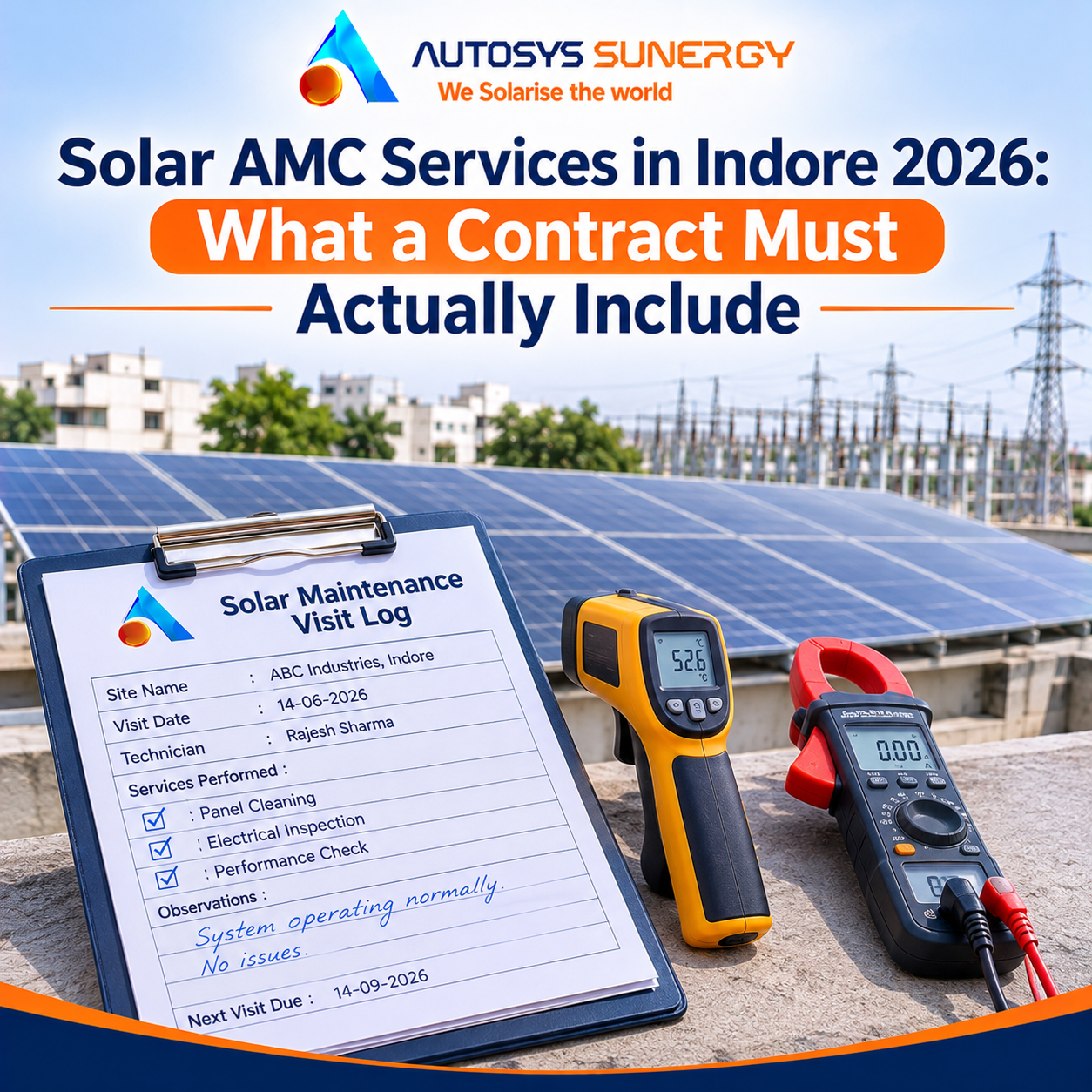
An AMC is not just housekeeping. It should create a reliable record of inspections, cleaning, faults, corrective work and generation performance. Those records can help you identify problems early and support a manufacturer's warranty claim, although the exact evidence required depends on the product warranty.
In simple terms: you are not only buying cleaning. You are buying documented maintenance, fault response and accountability for the work performed.
What you are actually buying
Direct answer: three different services are commonly sold under overlapping names. A basic AMC generally covers labour and scheduled inspections. A comprehensive AMC may include specified replacement parts. A full O&M contract adds ongoing monitoring, performance reporting and sometimes defined response or availability commitments. Warranty support is a separate service: it helps you claim against the manufacturer's warranty but does not replace that warranty.
The distinction that decides the price is simple: who pays when a component fails?
- Basic AMC — scheduled visits, visual inspection, cleaning if included, tightening and specified minor maintenance. Replacement parts are generally charged separately.
- Comprehensive AMC — the agreed maintenance work plus specified spare parts. The contractor pays for a covered replacement only when the component and failure fall within the contract's terms.
- Full O&M — adds generation monitoring, performance analysis, fault alerts, reporting and possibly defined response times or availability targets.
- Warranty support — documentation, diagnosis and coordination with the module or inverter manufacturer for eligible warranty claims. The manufacturer remains responsible for deciding the claim under its warranty terms.
Ask one question before accepting any quotation: which parts will you replace without charging me extra?
The answer should be a written list. It should identify whether the contract includes fuses, connectors, surge protection devices, fans, communication devices, inverter components or a complete inverter replacement. It should also state exclusions for lightning, flooding, vandalism, rodent damage, external electrical faults and accidental damage.
Key takeaway: the words on the cover mean very little. The scope of work, spare-parts schedule and exclusions decide what you are actually buying.
The five years you have already paid for
Direct answer: if your rooftop plant was installed through PM Surya Ghar using a registered vendor, the scheme requires five years of comprehensive operation and maintenance from the date of commissioning. The vendor's responsibility includes repairs and maintenance during the CMC period, subject to the scheme and agreement.
The MNRE operational guidelines state that registered vendors must provide repair and maintenance services free of cost for five years from commissioning. They also provide that non-performing or under-performing system components must be repaired or replaced free of cost during the CMC period.
The model agreement between the consumer and vendor includes five years of comprehensive operation and maintenance. It covers overhauling, wear and tear, and regular checks of system health at appropriate intervals. The agreement also requires the vendor to provide system warranty documentation and assist the consumer with manufacturer warranty claims.
Three details matter:
- The five-year period starts from commissioning, not from the date you paid an advance or signed the quotation.
- The vendor's CMC is part of the scheme installation obligation. A consumer should check the signed agreement and commissioning record before accepting an additional maintenance bill.
- The scope is broader than occasional inspection. The guidelines include repairs and maintenance and free repair or replacement of non-performing or under-performing components during the CMC period.
The consumer also has responsibilities. These include providing reasonable site access, following the vendor's instructions, using the system properly and reporting faults when they occur. The agreement describes cleaning education and best practices; the exact cleaning arrangement should be checked against the signed agreement and the applicable scheme documents.
If a registered vendor refuses to perform its CMC obligations, retain the agreement, commissioning record, photographs, fault reports and written communication. Raise the issue through the PM Surya Ghar National Portal grievance process and the relevant DISCOM or scheme authority. The guidelines provide for action against registered vendors, including possible de-registration or penalties after due process.
One important limitation: do not assume that the CMC automatically transfers to a new property owner when a house is sold. The agreement and scheme records should be checked, and the vendor should be asked in writing to confirm how the maintenance obligation will be handled after a change in ownership.
Our note on the rooftop solar subsidy in Indore covers the residential scheme and its consumer obligations.
In simple terms: check your commissioning date and signed agreement before buying an AMC. If your subsidised plant is still within its five-year CMC period, first ask the registered vendor to fulfil the maintenance obligation already included in the scheme.
What a contract must contain to keep a warranty alive
Direct answer: a manufacturer's warranty is conditional. Its terms differ by brand, product model and purchase date. A maintenance record can help establish how the system was operated and maintained, but there is no single universal document checklist that applies to every module and inverter.
For example, Waaree's limited warranty statement lists exclusions relating to negligent maintenance and failure to perform periodic system checks. Its warranty documentation also specifies the information and evidence required for a claim.
Depending on the manufacturer and the type of claim, useful records may include:
- The original purchase invoice and module or inverter serial numbers.
- The installation and commissioning documents.
- The system single-line diagram and equipment specifications.
- Electrical test and commissioning reports, where applicable.
- Periodic inspection and maintenance reports.
- Cleaning dates, cleaning method and water-quality records, where relevant.
- Inverter generation data, alarms and fault history.
- Photographs of the modules, mounting structure, cables and affected components.
- Details of any repair, replacement, firmware update or electrical modification.
A performance-related claim may require more evidence than a straightforward manufacturing-defect claim. Depending on the warranty terms, the manufacturer may request generation data, shading information, site photographs, testing results or a formal inspection.
The same principle applies to inverter warranties. Some manufacturers provide remote monitoring and firmware support, while others specify particular registration, connectivity or service procedures. Do not assume that every brand treats an offline inverter or a change of monitoring account in the same way.
A reliable solar company should hand the maintenance and commissioning record file to the owner. The owner should be able to access the documents even if the original installer stops operating.
Key takeaway: write the deliverables into the AMC: dated visit reports, inspection readings, cleaning records, fault logs, photographs and generation-data exports. Replace vague wording such as 'preventive maintenance as required' with a measurable schedule.
Cleaning is the biggest warranty risk on your roof
Direct answer: module manufacturers specify how their panels should be cleaned. Water temperature, cleaning tools, chemicals, pressure and timing can all matter. The correct method depends on the exact module model and its current installation or maintenance manual.
The limits are not identical across manufacturers:
- Water-to-module temperature difference — Waaree's published warranty conditions for certain module products specify a maximum temperature difference of 5°C. Trina's 182-series user manual specifies a range of −5°C to +10°C.
- Time of day — Trina advises against cleaning during the hottest part of the day to reduce thermal stress.
- Water chemistry — Jinko's O&M manual specifies water-quality limits, including pH, hardness and total dissolved solids. Other manufacturers may publish different requirements.
- Pressure — pressure limits depend on the module manual and cleaning equipment. A pressure figure from one brand should not be treated as permission to use the same pressure on another brand.
- Chemicals — some manufacturers permit specific mild cleaning agents, while others restrict or prohibit certain chemicals. Follow the manual for the modules installed at your site.
- Robotic cleaning — permission depends on the module manufacturer, robot design and operating conditions. Do not assume that a cleaning robot is automatically approved.
The practical rule is straightforward: follow the most restrictive applicable requirement for the actual modules installed on your roof. Do not combine specifications from different brands into one universal cleaning procedure.
The Jinko Solar O&M manual and Trina Solar user manual illustrate why a written cleaning procedure matters. Their recommendations are model-specific and should not be applied automatically to every module.
Cleaning should also be based on actual soiling and site conditions. Dust, bird droppings, industrial pollution, nearby trees and the tilt angle can affect how often a system needs attention. Excessive cleaning can increase labour costs and create avoidable risks.
Most solar vendors fail when they treat cleaning as automatically beneficial, without checking whether the cleaning method is permitted by the module manufacturer.
In simple terms: cleaning a panel incorrectly can create damage rather than prevent it. The contractor should follow the module manual, not a generic washing routine.
The Indore water problem
Direct answer: water quality and temperature deserve particular attention in Indore, especially where rooftop cleaning relies on borewell water. However, groundwater hardness and temperature vary by source and season. A contractor should test the actual water rather than assume every borewell has the same characteristics.
The risk has two parts.
First, water temperature matters. A large temperature difference between cleaning water and hot module glass can create thermal stress. This is why manufacturers publish temperature-difference limits and recommend avoiding cleaning during the hottest part of the day.
Second, water chemistry matters. Hard water can leave mineral deposits as it evaporates. Repeated deposits may reduce light transmission and make cleaning more difficult. Whether a particular water source is suitable depends on its measured hardness, dissolved solids and the module manufacturer's requirements.
So six clauses belong in any Indore AMC that includes washing:
- Cleaning should be scheduled when module temperature is within the manufacturer's permitted range, rather than relying only on a fixed clock time.
- Water quality should meet the module manufacturer's requirements. Use treated or softened water where the site-water test shows that it is necessary.
- A baseline water-quality report should be retained where borewell or other untreated water is used.
- Cleaning pressure and equipment should remain within the limits specified by the module manufacturer.
- Chemicals, detergents and solvents should not be used unless the module manufacturer permits them.
- Robotic cleaning equipment should be used only when it is compatible with the installed modules and the manufacturer's instructions.
The contractor should record the date, water source, cleaning method and any relevant measurements. If the water source changes, the suitability of that water should be checked again.
Key takeaway: specify the water-quality standard and cleaning procedure in the contract. In Indore, the actual water source and module temperature matter more than a generic promise to wash the panels every month.
Who owns the monitoring login
Direct answer: the owner should retain primary control of the inverter monitoring account and generation records. An installer may need access to diagnose faults, but that access should not prevent the owner from viewing the plant or changing service providers.
Monitoring platforms differ in how they handle account transfers and data retention. Fronius, for example, warns that deleting a Solar.web account also permanently deletes the associated production and consumption data. That makes account ownership and data export important before any account is removed.
Do not assume that every inverter brand behaves in the same way. Check the manufacturer's current instructions before transferring, unbinding or deleting an account.
Three clauses should appear in every AMC:
- The owner holds the primary monitoring account, registered with an email address and mobile number under the owner's control.
- The AMC contractor receives only the installer, service or supervisor access needed to perform its work. That access should be removable when the contract ends.
- The contractor exports and delivers generation records, alarm history and maintenance reports at agreed intervals, preferably at least once a year.
The owner should also keep copies of the inverter configuration, commissioning information, warranty registration and available data exports. Cloud platforms are useful, but they should not be the only place where the plant's history exists.
In simple terms: if you cannot access your own monitoring account or retrieve your generation history, you do not have proper control of your plant's records. Fix that before you need a warranty claim.
What an AMC should cost
Direct answer: there is no regulator-published retail AMC tariff for rooftop solar in Indore. The price depends on plant capacity, roof access, number of visits, monitoring, testing instruments, response times and whether replacement parts are included.
Public procurement examples provide a reference, but they should not be mistaken for standard household prices:
- Labour-only maintenance — some rate contracts price work by visit, site or installed capacity. The quoted amount is meaningful only when the number of visits and included activities are stated.
- Normative O&M estimates — benchmark assumptions used for project planning are not necessarily the price a homeowner or factory will pay under a private AMC.
- Large residential portfolios — bulk contracts can achieve lower per-kW rates because many systems are maintained under one coordinated programme.
- Existing commercial rooftop portfolios — comprehensive contracts may cost more per kW where they include monitoring, corrective maintenance, multiple locations and defined service obligations.
For context, a 2026 Gujarat municipal tender for comprehensive O&M of 500 kWp of existing rooftop systems over three years carried an estimated value of approximately ₹28.47 lakh. That works out to around ₹1,898 per kWp per year when the estimated tender value is divided by the capacity and contract term. It is a public procurement estimate for a multi-site portfolio, not a confirmed Indore retail rate or a guaranteed awarded price.
Two adjustments matter in Indore. First, a small residential plant may not receive a proportionately low per-kW quote because travel, roof access, safety arrangements and technician time still create a minimum visit cost. Second, a single contiguous factory roof can be cheaper to service per kW than several scattered residential or commercial sites.
For a small home, judge the quotation on price per documented technical visit, not just price per kW. For a commercial or industrial plant, compare the full annual scope, monitoring, response time and spare-parts liability.
Key takeaway: do not treat one public tender or a low per-kW quotation as the market rate for every plant. Compare the actual visits, records, instruments, response commitments and spares included.
Comprehensive or basic? The inverter decides
Direct answer: comprehensive cover is not automatically better value. The decision depends on the age of the plant, remaining manufacturer warranties, the price difference between plans and the contractor's ability to honour its spare-parts commitments.
Solar modules may carry long performance warranties, but that does not mean every component has the same warranty period. Inverters, communication devices, surge protection devices, fans and other electrical components may have different product warranties and replacement conditions.
The inverter is often one of the most expensive components to replace. Its expected service life depends on the model, operating environment, temperature, ventilation, electrical conditions and maintenance. It is therefore better to assess the actual inverter warranty and condition than assume that every inverter will fail in a fixed year.
Use this calculation before choosing a plan:
- Find the annual price difference between the basic and comprehensive AMC.
- Multiply that difference by the full contract term.
- Identify which components are included in the comprehensive plan.
- Compare the total premium with the likely out-of-pocket cost of those components.
- Check exclusions, replacement conditions, response time and the contractor's financial ability to honour the agreement.
Three conclusions follow:
- During the manufacturer's warranty period — check whether the AMC duplicates coverage already available under the product warranty or a scheme CMC. A paid comprehensive plan may still provide useful labour or monitoring, but it should not charge you twice for the same obligation.
- For older residential systems — a basic maintenance contract plus a separate repair reserve may be more economical than paying a high annual spares premium. Compare the actual inverter condition and the availability of replacement parts.
- For commercial and industrial systems — comprehensive cover may be defensible where downtime is expensive, but only when the contract defines covered components, replacement quality, response times and exclusions.
That last point is important. Paying an annual spares premium is useful only if the contractor can actually supply the replacement when the failure occurs. Ask whether the replacement will be new, refurbished or equivalent in specification, and whether labour, transport and commissioning are included.
Our 50 kW factory guide sets out the capital-cost considerations for a commercial installation.
Most solar vendors fail when they sell a comprehensive plan without explaining which existing manufacturer or scheme warranties already cover the same components.
In simple terms: compare the coverage you already have with the extra protection being offered. Buy comprehensive cover only when its additional benefits justify the premium.
Taking over a plant someone else built
Direct answer: a plant installed by another contractor can usually be inspected and maintained by a new service provider. But a takeover should begin with a documented condition audit, not an assumption that the new contractor can certify the plant's entire history.
The takeover survey should establish the present condition of the system:
- Inverter model, firmware version, configuration and commissioning information.
- String layout, module count and electrical readings.
- Connector condition and compatibility across each mated connection.
- DC cable sizing, routing, insulation condition and visible damage.
- Earthing and bonding condition, with test results where required.
- Mounting-structure fasteners, corrosion, roof penetrations and visible water ingress.
- Module serial numbers photographed clearly.
- Available invoices, warranties, installation drawings and previous service records.
- Monitoring-account ownership and the availability of generation and fault history.
The audit should separate what can be verified from what cannot. For example, the new contractor may be able to test present insulation resistance and inspect the mounting structure, but may not be able to prove how modules were stored before installation or whether hidden micro-cracks existed from the beginning.
Never ask a contractor to recreate historical maintenance reports for visits it did not perform. A backdated or fabricated record can damage the credibility of a future warranty claim.
The takeover report should include photographs, readings, identified defects, recommended corrective work and a clear statement of limitations. Any unsafe condition should be recorded and addressed before the plant is returned to normal operation.
The best solar company is defined by what it refuses to certify about work it did not do.
Key takeaway: a takeover audit creates a defensible record of the plant's condition from today forward. It cannot restore missing historical evidence, but it can prevent further documentation gaps.
The power factor trap on commercial roofs
Direct answer: adding solar can affect a commercial consumer's grid-import power factor because the active power drawn from the grid may fall while reactive demand remains. This can affect the power-factor incentive or surcharge shown on the electricity bill. However, the actual impact must be assessed using the consumer's monthly metering data, not a single instantaneous calculation.
The distinction matters because the MP Electricity Supply Code defines power factor as the average monthly ratio of total kilowatt-hours to total kilovolt-ampere-hours supplied during the month. It is not simply the power factor measured at one moment.
Consider an illustrative factory drawing 200 kW of active power and 60 kVAr of reactive power at a particular moment. Its apparent power is approximately 208.8 kVA, giving an instantaneous power factor of about 96%.
If a solar system supplies 120 kW of the factory's active demand while reactive demand remains at 60 kVAr, grid active import falls to 80 kW. Under those simplified instantaneous assumptions, apparent grid import becomes 100 kVA and the power factor is 80%.
This illustrates the mechanism, but it does not predict the factory's monthly billed power factor. Actual billing depends on the full load profile, solar generation profile, inverter operating settings, reactive-power behaviour and the meter's recorded kWh and kVAh.
Under the MPERC FY 2026–27 tariff order, eligible non-domestic consumers can receive power-factor incentives from 86% upward. The incentive rises with the recorded power factor, reaching 6% at 96%. The tariff order also sets an 80% minimum power-factor requirement for relevant consumers, with a surcharge applying below that level.
The practical consequences are:
- A solar installation can change the relationship between active grid import and reactive demand.
- Existing capacitor banks and automatic power-factor correction systems should be checked after solar commissioning.
- Inverter reactive-power settings must follow the applicable grid requirements and equipment capabilities.
- Harmonic distortion and resonance risks should be assessed before changing capacitor-bank capacity.
- The plant's monthly kWh, kVAh and power-factor readings should be compared before and after solar commissioning.
A simplified example also shows why the exact calculation matters. If grid active import falls from 80 kW to 60 kW while reactive demand remains at 60 kVAr, the instantaneous power factor falls from 80% to approximately 70.7%. That is a reduction of about 9.3 percentage points, not 16. It would be a warning that the site's reactive-power correction needs an engineering review, not proof that every 140 kW solar system will trigger a 10% surcharge.
Do not specify a capacitor-bank size, detuning percentage or controller arrangement from a generic article. The correct solution depends on the site's load profile, harmonic measurements, transformer arrangement, inverter settings and protection design.
In simple terms: the correction panel that worked before solar was installed may need to be reviewed after the grid-import profile changes. Check the actual monthly power-factor data instead of assuming that the inverter or capacitor bank is configured correctly.
This is why power factor belongs in the conversation when solar goes onto a load-heavy production floor, and why commercial solar economics should be modelled using the complete electricity bill.
Power-factor correction equipment is plant electrical infrastructure, not automatically part of a solar AMC. It can be included as a separate scope or a clearly priced additional service. The solar AMC should, however, record relevant power-factor readings or flag significant changes where the contractor has access to the required meter data.
In simple terms: commission the solar plant and review the power-factor correction system together. Otherwise, a reduction in energy charges may be partly offset by a power-factor penalty.
What the law requires of you anyway
Direct answer: maintenance is not purely contractual. The Central Electricity Authority's safety regulations require electrical installations to be maintained in a safe condition and provide for periodic inspection and testing or self-certification, depending on the installation and applicable requirements.
The CEA Measures relating to Safety and Electric Supply Regulations, 2023 replaced the earlier 2010 regulations. Regulation 32 addresses periodic inspection and testing. For installations at or below the notified voltage, self-certification provisions apply; the periodicity is directed by the appropriate government and must not exceed five years. The regulations also place responsibility on the owner to maintain and operate installations in a condition free from danger and in accordance with manufacturer recommendations and relevant standards.
The exact inspection, testing and certification requirements depend on the installation's voltage, category and applicable state directions. An AMC does not automatically replace every statutory inspection, test or certification requirement.
For industrial premises, electrical safety, access control, isolation procedures and work-at-height precautions also need to be addressed independently of the AMC.
So an expired AMC does not remove the owner's safety responsibilities. If an electrical installation becomes unsafe, the fact that a maintenance contract has lapsed does not make the condition acceptable.
Key takeaway: treat statutory testing and safety requirements as the minimum. Use the AMC to organise inspections, maintenance and records, but do not assume that signing a contract transfers every legal responsibility away from the owner.
Frequently asked questions
How much does a solar AMC cost in Indore?
There is no government-fixed retail AMC rate. The price depends on system size, number of visits, roof access, monitoring, testing and whether spares are included. Compare the price per documented visit for a small home and the complete annual scope for a commercial plant.
Do I need an AMC if my system is under warranty?
You need appropriate maintenance, but you may not need an additional paid AMC. A manufacturer's warranty covers specified product defects under its terms; it does not necessarily include routine inspection, cleaning or monitoring. If your installation is covered by PM Surya Ghar's five-year CMC, check the registered vendor's existing obligation before paying separately.
Can poor cleaning void my panel warranty?
Improper cleaning can affect warranty coverage where the manufacturer's terms exclude damage caused by unsuitable cleaning methods, chemicals, temperature differences or equipment. Follow the cleaning instructions for the exact module model installed at your site.
Is comprehensive AMC worth it?
It depends on the components covered, the remaining manufacturer warranties, the plant's age and the cost of downtime. It may be worthwhile for a commercial plant where a covered failure would cause significant losses, but only if replacement parts and response commitments are clearly defined.
Who should hold the monitoring login?
The owner should hold the primary account on an email address and mobile number they control. The contractor can receive service access, but the owner should retain the ability to view the plant and export its records.
My installer has closed. Can anyone take over my plant?
Yes. A new contractor can inspect and maintain the plant after a takeover audit. The audit should document the present condition, available records, faults and any limitations caused by missing historical information.
Before you sign
Judge an AMC quotation on four things, in this order: the named spare-parts list, the documented deliverables per visit, who controls the monitoring account, and whether the cleaning specification follows the manufacturer's instructions.
Price comes after scope. A cheap contract that provides no meaningful inspection reports, fault records or evidence of maintenance may leave you with little support when a component fails.
A reliable solar company always tells a subsidised customer to check the first five years of CMC already included under PM Surya Ghar before buying another maintenance contract.
If you have a plant in Indore and are unsure what your arrangement covers, compare the signed AMC, commissioning date, manufacturer warranty documents and monitoring access. Check what is already covered and what remains your responsibility.
We will review an existing contract with you as part of scoping our maintenance and installation services, including identifying services you may not need to purchase again. For plants we did not build, our EPC team can assess the system through a standalone takeover audit.
Key takeaway: ask any AMC provider one question — what will I physically receive at the end of each visit and each year? If the answer is not a clear set of reports, readings, photographs and service records, keep looking.
Keywords