Direct answer: The PM Surya Ghar Yojana application moves through a series of stages on the national portal, with responsibility passing between you, the DISCOM and your registered vendor. The portal presents the process in a simplified format, but understanding the individual actions behind it makes delays easier to identify.
Two important actions require your attention: verifying and forwarding the installation details submitted by your vendor, and redeeming the subsidy e-token after it has been activated. These steps cannot simply be completed by waiting for the DISCOM or vendor to act.
The second action directly affects when you receive the money. The subsidy is not transferred merely because the system has been installed or commissioned. You must log in to your consumer profile and redeem the activated e-token.
Everything else — documents, feasibility, vendor selection, installation, inspection and payment — follows a defined sequence. This guide explains who is responsible at each stage and what you should check before moving forward.
In simple terms: many application delays happen because a required action, document or approval is still pending with the consumer, vendor or DISCOM.
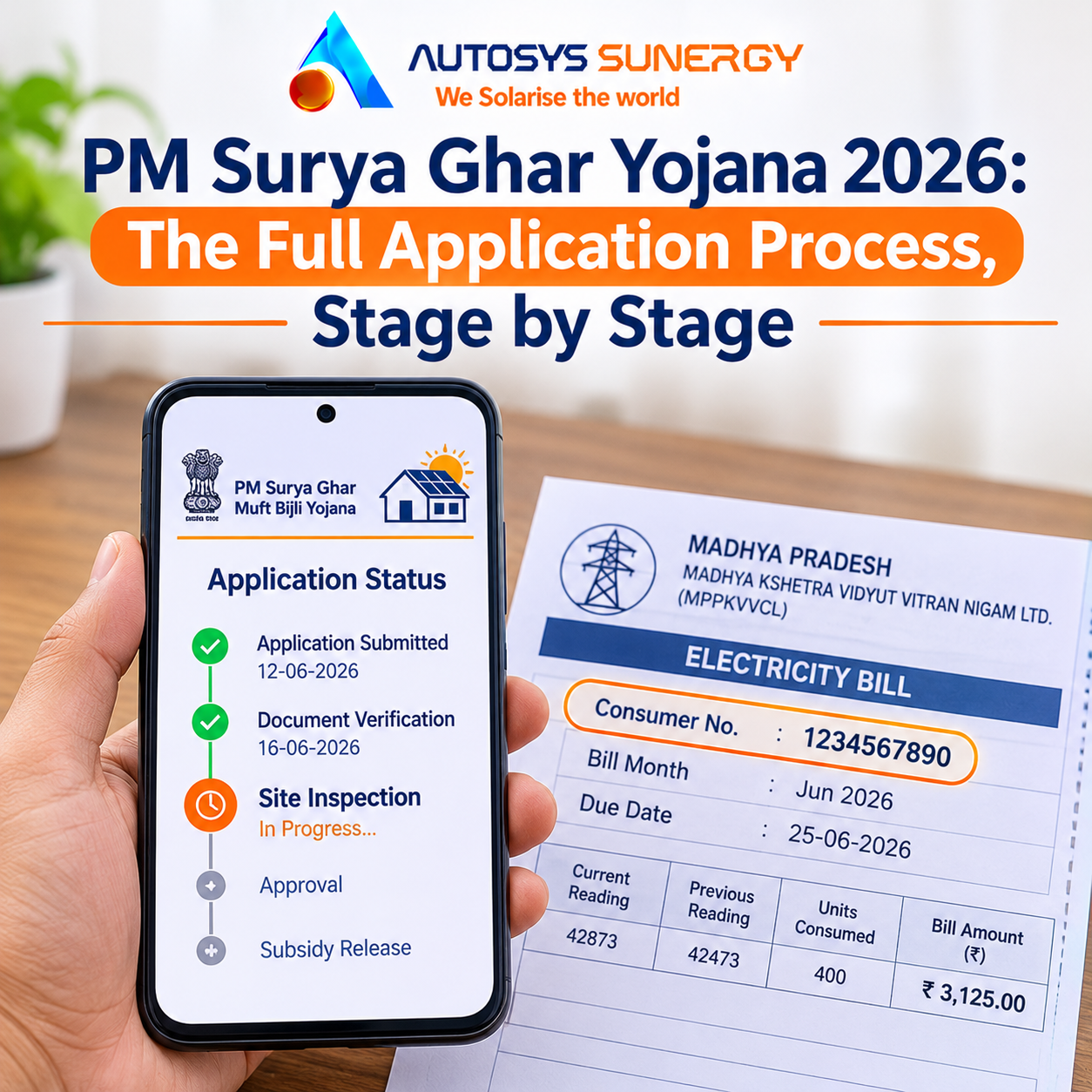
The ten stages, and who holds the file
Direct answer: the PM Surya Ghar national portal provides a simplified application journey. For practical tracking, it helps to break the process into ten stages. Responsibility moves between you, the DISCOM and your vendor, with the final subsidy redemption requiring your own action.
- 1. Consumer registration — you register using your mobile number and complete the required verification.
- 2. Application submission — you submit the application using your electricity consumer account number and the details requested by the portal. A vendor may assist.
- 3. Feasibility approval — the DISCOM processes the application. Complete applications for systems up to 10 kW are deemed accepted without a technical feasibility study under the applicable central rules.
- 4. Vendor selection and agreement — you select a registered vendor, mutually agree on the price and specifications, and complete the required agreement.
- 5. Plant installation — the selected vendor installs the rooftop solar system.
- 6. Installation details — the vendor uploads the technical and installation information. You must review and complete the consumer-side action requested on the portal.
- 7. Inspection and metering — the DISCOM physically verifies the installation and completes the required metering and agreement formalities.
- 8. Commissioning — the DISCOM completes its report and the system is commissioned after the required approvals.
- 9. Subsidy redemption — after the e-token is activated, you log in and redeem it.
- 10. Subsidy disbursal — the National Programme Implementation Agency processes the eligible Central Financial Assistance (CFA) for transfer to the verified bank account or linked loan account.
The most important distinction is between a vendor uploading information and the consumer completing the next action. A vendor may assist with the portal, but the official guidelines give consumers the right to undertake portal activities without depending on the vendor.
Keep the registered mobile number, login credentials and bank details under your control. Do not rely entirely on a vendor to tell you when a consumer-side action is pending.
Key takeaway: if your application has not moved for several days, check the exact portal status first. Identify whether the next action belongs to you, your vendor or the DISCOM before escalating the delay.
What you upload, and what fails
Direct answer: the application requires your electricity connection details and the information requested by the portal. Bank proof is also required for subsidy processing. After installation, additional technical documents and geo-tagged photographs are submitted as part of the verification process.
It is important to separate the initial application from the post-installation documents.
At the application stage, keep these details ready:
- Your valid electricity consumer account number or CAN from the DISCOM.
- Your registered mobile number and email address.
- Your electricity bill and the connection details requested by the portal.
- Your proposed solar capacity.
- Bank account details and proof showing that the account belongs to the concerned consumer.
For bank verification, the guidelines allow documents such as a cancelled cheque, bank e-statement, passbook scan or another electronic document that certifies the account number and account ownership.
After installation, the vendor must provide and upload the required system information. This can include module details and serial numbers, domestic-content compliance information, inverter specifications, installation photographs with GPS coordinates, the completion report and relevant electrical drawings.
The DISCOM also completes its inspection report and the required metering agreement before the CFA can be processed.
The most important detail to check is the name on the electricity connection and the bank account. The consumer manual specifically instructs applicants to ensure that the bank account holder's name matches the electricity connection consumer's name.
For example, if the electricity connection is registered as “R K Sharma” but the bank account is held under a different name format, the discrepancy may require correction before the subsidy can be released. Do not assume that initials, joint-account arrangements or spelling differences will automatically be accepted.
In simple terms: check the consumer name, account number, IFSC and bank proof before submitting the application. Correcting a mismatch early is easier than resolving it after commissioning.
Feasibility: why up to 10 kW is easier
Direct answer: complete rooftop solar applications for systems up to 10 kW are deemed accepted without a technical feasibility study under Rule 11(7A) of the Electricity (Rights of Consumers) Amendment Rules, 2024. Any corresponding enhancement of sanctioned load required for the system must be carried out by the distribution licensee.
This is an important change for residential applicants. Earlier, consumers often expected a separate feasibility assessment before proceeding with installation. The amended rules simplified the process for complete applications up to 10 kW.
For systems above 10 kW, a technical feasibility study is required. The applicable central rules provide a 15-day period for completing the study and communicating the result. If the study is not completed within that period, the proposal is presumed technically feasible under the rule.
There is one practical point that applicants should understand: deemed feasibility does not mean every other payment or compliance requirement disappears. The Ministry of Power's July 2024 communication clarified that an application under the up-to-10-kW mechanism should not be withheld merely because the consumer has not filed a separate load-enhancement application or paid the associated charges and arrears. Those amounts may be recovered before commissioning.
Therefore, an application should not be treated as requiring a conventional feasibility study simply because the consumer has an existing sanctioned load lower than the proposed solar capacity.
The best solar company is one that checks your electricity connection and sanctioned load before recommending a system, rather than discovering connection-related issues after installation has started.
Key takeaway: for a complete application up to 10 kW, technical feasibility is deemed accepted. Check the consumer details and any applicable charges instead of assuming that a separate feasibility survey is required.
The sanctioned load trap on a Madhya Pradesh bill
Direct answer: the “Authorized Load” printed on a Madhya Pradesh electricity bill is not necessarily the same as your sanctioned load. Solar applications and connection approvals must be understood using the sanctioned load recorded by the DISCOM.
The Madhya Pradesh Electricity Supply Code distinguishes between the two.
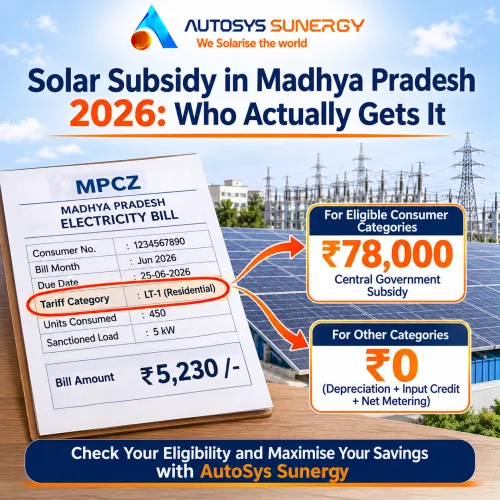
Authorized Load is an estimated load derived from electricity consumption. Under the amended definition, it is expressed in multiples of 0.1 kW, based on 15 units of monthly consumption for each 0.1 kW. It may be more or less than the sanctioned load and is not used as a substitute for sanctioned load when determining the total connected load.
For example, a household consuming around 450 units in a month may show an Authorized Load of approximately 3 kW. That figure is a consumption-based estimate. The sanctioned load recorded in the DISCOM's connection records may be different.
Why does this matter? Your sanctioned load is part of the connection information used when assessing the system and its grid connection. If you assume that the Authorized Load on your bill is the sanctioned load, you may misunderstand the capacity recorded by the DISCOM.
The process for rooftop solar systems up to 10 kW provides for the corresponding sanctioned-load enhancement where required. However, you should still confirm the actual sanctioned load and any applicable charges with the DISCOM before finalising the system capacity.
This is why our subsidy guide for Indore recommends checking the electricity connection details before choosing a system.
In simple terms: do not calculate your sanctioned load from the Authorized Load figure printed on the bill. Confirm the sanctioned load in the DISCOM's records.
Single phase or three phase?
Direct answer: Madhya Pradesh's Fifth Amendment to the Electricity Supply Code, effective from 28 March 2025, raised the normal maximum sanctioned load at 230 V single-phase supply to 5 kW. Above 5 kW, the normal supply-voltage arrangement moves to 400 V.
This is important because older information may still refer to a 3 kW single-phase limit.
Regulation 3.4 of the amended Supply Code sets the normal voltage-wise limits:
- 230 V: maximum sanctioned load of 5 kW.
- 400 V: minimum sanctioned load above 2 kW, with the applicable maximum depending on the tariff arrangement.
This means that between more than 2 kW and 5 kW, the prescribed limits overlap. A 400 V connection may be used, but a 230 V connection is also within the stated maximum.
The regulation also allows the licensee to deviate from the normal voltage arrangement where sufficient technical grounds exist, provided the reasons are recorded in writing.
Before agreeing to a three-phase conversion, ask the DISCOM to explain the requirement under Regulation 3.4 as amended. A conversion may involve additional charges, a security deposit and meter-related work, so it should not be treated as automatically necessary for every 5 kW residential system.
If you are comparing system sizes, our 5 kW solar guide and rooftop solar price list explain the cost differences between capacities.
Key takeaway: a 5 kW sanctioned load at 230 V single phase is permitted under the amended Madhya Pradesh Supply Code. If a conversion is proposed, ask for the specific technical or regulatory reason.
Choosing a vendor on the portal
Direct answer: you must select a vendor registered on the national portal for the relevant state and DISCOM. The vendor's price and system specifications are mutually agreed with you; the scheme does not impose one fixed retail installation price for every household.
The vendor-selection stage deserves careful attention for three reasons.
First, the installation must be carried out through a vendor registered on the portal for the applicable DISCOM. Choosing an unregistered contractor can put your subsidy eligibility at risk.
Second, the vendor and consumer must complete the required agreement. This document records the system specifications, responsibilities, project cost, payment terms, installation obligations and maintenance commitments.
Third, the agreement is not just a formality. The model vendor-consumer agreement includes five years of comprehensive operation and maintenance and specifies performance obligations for the installed system. It also requires the vendor to provide relevant documents and assist with the subsidy process.
Before selecting a vendor, compare more than the headline quotation. Check the module and inverter specifications, domestic-content compliance, mounting structure, electrical protection, installation scope, net-metering responsibilities, warranties and maintenance commitments.
The vendor should also explain which payments are due at each project milestone and what happens if installation or commissioning is delayed.
A vendor who treats the model agreement as a formality may leave you with unanswered questions about maintenance and performance after installation.
In simple terms: the portal controls which vendors can participate in the scheme. You still need to compare their quotations, technical specifications and contractual responsibilities before choosing one.
Inspection, the meter and commissioning
Direct answer: after installation, the DISCOM physically verifies the rooftop solar system, completes the required connection and metering formalities, and records the commissioning details. The CFA process can move forward only after the required inspection, agreements and commissioning information are complete.
Before expecting an inspection, make sure your vendor has submitted the installation certificate and the required installation information. Check the consumer-side action on the portal as well.
Under the Madhya Pradesh grid-interactive renewable energy regulations, after submission of the installation certificate for a solar photovoltaic system, the distribution licensee is required to complete the connection agreement, meter installation and successful commissioning within 15 days.
The inspection and documentation process may involve checks relating to the installed equipment, applicable technical specifications, domestic-content compliance, electrical safety and the metering arrangement.
Your vendor should provide the documents needed for verification and should coordinate with the DISCOM on the installation and commissioning requirements. Keep copies of the installation certificate, technical documents, photographs and metering agreement.
Once the DISCOM has completed the required checks, its report is recorded through the portal. The commissioning status is an important milestone, but it does not itself complete the consumer's subsidy-redemption action.
A reliable solar company coordinates with the DISCOM and remains available during inspection and commissioning, rather than treating installation as the end of its responsibility.
In simple terms: the DISCOM can process the inspection only after it receives the required installation information. Check that your vendor has submitted it correctly and that no consumer-side action is pending.
Key takeaway: installation, inspection, metering and commissioning are separate steps. Do not assume that the subsidy process is complete as soon as the panels are installed.
The money: seven conditions and one button
Direct answer: the subsidy is released only after the scheme's eligibility, installation, inspection, documentation and bank-verification requirements are satisfied. The final consumer-side action is redeeming the activated e-token through your own portal login.
The following are the main requirements for a standard consumer-owned residential installation under the scheme:
- Eligible residential electricity connection: the system must be connected to an eligible residential electricity connection and meet the scheme's requirements. The ordinary CFA route covers consumer-funded installations, including installations financed through a bank loan. RESCO arrangements have separate provisions.
- Registered vendor: the installation must be carried out through a vendor registered on the national portal for the relevant DISCOM.
- Domestic Content Requirement: the solar modules must meet the scheme's DCR condition, meaning the modules must be domestically manufactured using domestically manufactured solar cells. Check the vendor's documentation and the equipment actually installed.
- Completed installation and photographs: the required pre-installation and completed-installation photographs, including GPS information, must be uploaded.
- Physical inspection and metering formalities: the DISCOM must verify the system, complete the required agreements and record its report and commissioning details.
- Verified bank details: the consumer must submit proof that the bank account belongs to the concerned consumer. If the system is financed through the scheme's loan route, the relevant loan-account details must also be recorded.
- E-token redemption: after the National Programme Implementation Agency has assessed the documents and activated the e-token with the admissible CFA amount, the consumer must log in and redeem it.
These requirements are described in the official PM Surya Ghar operational guidelines.
There are three points that applicants should understand.
First, the subsidy is calculated on the rated DC capacity of the solar modules, not the inverter capacity. If the module capacity is higher or lower than the inverter capacity, the CFA calculation follows the module system's rated capacity, subject to the scheme rules.
Second, the subsidy is not an upfront discount automatically deducted from the vendor's quotation. Under the ordinary consumer-owned capex process, you pay the agreed project cost and the eligible CFA is transferred after the required approvals and redemption.
Third, if you financed the installation through the scheme's loan route, the CFA is transferred to the linked loan account. If the CFA is greater than the loan amount drawn, the outstanding loan amount is credited first and the surplus is transferred to your bank account.
The standard CFA rates are:
- ₹30,000 per kW for the first 2 kW.
- ₹18,000 for the additional third kW.
- No additional CFA beyond 3 kW under the ordinary residential structure.
This is why the maximum standard CFA for eligible households in most states is ₹78,000. Our 2 kW solar system guide and 3 kW solar system guide explain how the capacity affects the subsidy.
The guidelines state that CFA should be processed within 15 days after the application meets the requirements specified in the guidelines. This is the official processing provision; it should not be confused with a guaranteed 15-day period starting on the day of physical installation or before all required documents and approvals are complete.
In simple terms: commissioning does not automatically pay the subsidy. Once the e-token is activated, you must redeem it through your own consumer login.
Why the subsidy did not arrive
Direct answer: if your system has been commissioned but the subsidy has not reached your account, first check whether the application has completed the required verification and whether the activated e-token has been redeemed. Then verify the bank details and the portal's current status.
Use this checklist:
- Redeem Subsidy has not been clicked: check whether the e-token is activated and whether you have completed the redemption action from your own login.
- Name mismatch: compare the name on the electricity connection with the bank account holder's name. Correct any spelling, initials or other differences with the relevant institution.
- Incorrect bank details: verify the account number and IFSC entered on the portal against your bank records.
- Bank-account proof is unclear or incomplete: check whether the uploaded cancelled cheque, passbook copy or statement clearly establishes that the account belongs to the consumer.
- Loan-account details are incorrect: if you financed the installation through a loan, confirm that the correct loan account has been linked.
- Application is awaiting verification or correction: check the portal for a returned application, pending document, inspection status or other specific reason.
Do not assume that every delay is caused by the bank. The payment can remain pending because the e-token has not been activated, the required documentation has not been accepted or the consumer has not completed redemption.
If the portal shows that all required actions have been completed but the money is still pending, raise a grievance through the national portal. The scheme guidelines provide for a two-level escalation process and state that grievances raised through the portal should be resolved within 30 days. Keep the grievance tracking ID and copies of the relevant bank and application records.
A vendor should not close communication with the customer immediately after commissioning. The customer still needs the correct documents, status updates and assistance if the application is returned for correction.
Key takeaway: check the e-token and portal status first, then verify the bank information. If the application remains unresolved, raise a tracked grievance instead of relying only on verbal follow-ups.
If the discom delays, they owe you ₹500 a day
Direct answer: Madhya Pradesh's grid-interactive renewable energy regulations provide for compensation of ₹500 per day where the distribution licensee delays without just cause. The provision applies to a delay attributable to the DISCOM under the relevant regulatory timelines; it is not a general penalty for every delay in the solar-subsidy process.
Regulation 6(l) of the MPERC Grid Interactive Renewable Energy Systems and Related Matters Regulations states that where the licensee delays without just cause, it is liable to pay compensation to the consumer at ₹500 for each day of default.
For solar photovoltaic systems, the relevant timeline is particularly important. Under the state's regulations, after the installation certificate has been submitted, the DISCOM must complete the connection agreement, meter installation and successful commissioning within 15 days.
It is worth being precise about what this provision covers.
The compensation relates to an unjustified delay by the DISCOM in carrying out its regulatory responsibilities. It does not mean that every pending application automatically earns ₹500 per day. A delay caused by incomplete documents, a pending consumer action or an unresolved vendor obligation is not automatically a DISCOM default.
It also does not apply to a delayed CFA transfer by the national implementing agency. Subsidy-related delays should be raised through the scheme's grievance mechanism.
If the DISCOM misses the applicable timeline without just cause, retain the dated installation certificate submission, portal status, inspection records and written communication. These records help establish when the regulatory clock started and what action remained pending.
A reliable solar company should explain the DISCOM's applicable timelines and help the consumer maintain the records needed to follow up on a delay.
In simple terms: date-stamp the installation certificate submission and keep the portal acknowledgement. A compensation claim depends on proving when the DISCOM's deadline began and that the delay was without just cause.
Does 31 December 2026 affect you?
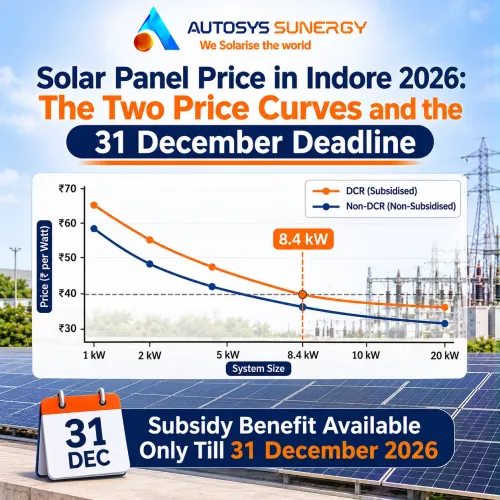
Direct answer: the 31 December 2026 date relates to a limited exemption from ALMM List-II for solar PV cells for specified net-metering and open-access projects. It is not the general PM Surya Ghar application deadline, and it does not remove the scheme's Domestic Content Requirement.
MNRE's 18 July 2026 clarification provides a limited window under which net-metering and open-access renewable energy projects commissioned by 31 December 2026 can receive an exemption from ALMM List-II for solar PV cells.
The distinction between the two lists matters:
- ALMM List-I relates to approved solar PV modules.
- ALMM List-II relates to approved solar PV cells.
The exemption described in the July clarification concerns List-II for cells. It does not remove the applicable List-I requirement for modules.
There is another important distinction for PM Surya Ghar applicants. The scheme's Domestic Content Requirement is separate from ALMM. Residential consumers claiming CFA must continue to use domestically manufactured modules made from domestically manufactured solar cells. An ALMM clarification does not cancel that DCR obligation.
MNRE's 4 August 2026 clarification further explains the position for different project categories. It states that certain residential rooftop projects under PM Surya Ghar that opt to Give Up the Subsidy and use net metering are exempt from ALMM List-II for cells until the scheme period ends on 31 March 2027, subject to the stated portal conditions. The clarification also makes clear that the relevant DCR requirements remain separate and are not relaxed by ALMM orders.
Therefore, do not assume that every subsidised residential installation is automatically exempt from every ALMM requirement. Ask the registered vendor to confirm the applicable List-I, List-II and DCR requirements for your specific project and commissioning date.
For households claiming the standard subsidy, the more immediate practical priorities remain correct application details, a compliant DCR installation, inspection, metering and e-token redemption.
The scheme guidelines state that the implementation period runs until 31 March 2027, and eligible claims must be settled within that period. This is the scheme's stated implementation period; it should not be presented as a separate universal deadline requiring every applicant to complete installation details by that exact date.
If you are planning an installation near the end of 2026, ask your vendor to confirm equipment compliance and the commissioning schedule in writing. Do not rely on a quotation that simply says “ALMM compliant” without identifying the relevant module and cell requirements.
Key takeaway: 31 December 2026 is an ALMM List-II transition date for specified projects, not a blanket PM Surya Ghar application deadline. DCR requirements for households claiming CFA remain in force.
Frequently asked questions
How long does the PM Surya Ghar application take? Registration and application submission can be completed quickly if your consumer details are correct. Complete applications up to 10 kW are deemed accepted without a technical feasibility study. Installation, inspection, metering and commissioning take additional time depending on the vendor and DISCOM. The CFA guidelines provide for processing within 15 days after the application meets the specified requirements.
Why has my subsidy not been credited? First check whether the DISCOM inspection and commissioning are complete, whether the e-token has been activated and whether you have redeemed it through your own login. If redemption is complete, verify the bank account details, account ownership proof and any linked loan-account information.
Can I apply without a vendor? You can register and submit the application through your own consumer login, and you retain the right to undertake portal activities without depending on the vendor. However, the installation must be carried out through a vendor registered on the national portal for the relevant DISCOM if you are claiming CFA under the ordinary capex route.
Do I get the subsidy deducted from my bill or my quotation? No. Under the ordinary consumer-owned installation route, you pay the agreed project cost and receive the eligible CFA after the required verification and e-token redemption. If you use the scheme's loan route, the CFA is transferred to the linked loan account first.
Does a 5 kW system need a three-phase connection in MP? Not automatically. The amended Madhya Pradesh Supply Code permits up to 5 kW sanctioned load at 230 V single phase. The licensee may require a different arrangement where it has sufficient technical grounds and records the reasons in writing.
What if the DISCOM simply does not inspect my plant? Madhya Pradesh's grid-interactive renewable energy regulations provide a 15-day timeline for the DISCOM to complete the required connection agreement, meter installation and commissioning after submission of the installation certificate for a solar PV system. Where the licensee delays without just cause, the regulations provide for ₹500 per day in compensation. Keep dated proof of submission and follow up through the appropriate grievance channel.
Before you apply
Do three things before you start the process.
First, confirm your sanctioned load with the DISCOM rather than assuming that the Authorized Load printed on your electricity bill is the same figure.
Second, check that the name on your electricity connection matches the name on the bank account you intend to use for subsidy payment. Keep a clear cancelled cheque, passbook copy or bank statement ready as proof of account ownership.
Third, choose a registered vendor and review the quotation and agreement carefully. Confirm the module and cell compliance, system capacity, inverter specifications, installation scope, payment milestones and five-year maintenance responsibilities before signing.
Once your application is active, keep an eye on two important consumer actions: the installation details submitted by your vendor and the activated subsidy e-token. Review the portal when the vendor sends the installation information, and redeem the e-token yourself when it becomes available.
If you are in Indore or elsewhere in Madhya Pradesh and want help with the application and installation process — including checking the sanctioned load, reviewing the connection details and coordinating with the DISCOM — these are part of how we scope our solar installation services. Our EPC team also handles the DISCOM coordination required for larger systems.
Key takeaway: PM Surya Ghar is a sequence of consumer, vendor and DISCOM actions. Know who is responsible for the next step, keep your documents ready and complete your own portal actions on time.
Keywords